Monday, April 16, 2012

(JDW) Images suggest North Korea using Chinese TEL for new missile

ASIA PACIFIC
Date Posted: 16-Apr-2012

Jane's Defence Weekly


Images suggest North Korea using Chinese TEL for new missile

Ted Parsons JDW Correspondent
Washington, DC

Additional reporting by
James Hardy Asia-Pacific Editor
London

Key Points

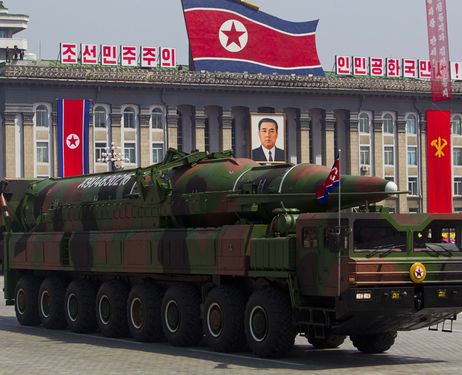
  • Images taken in Pyongyang on 15 April suggest that North Korea's new missile is transported by a transporter-erector-launcher of Chinese design
  • If this is confirmed, the TEL would be in breach of UN sanctions designed to prevent weapons proliferation by North Korea

 Images suggest that China has either sold the design or manufactured the transporter-erector-launcher (TEL) vehicle for the three-stage missile that North Korea unveiled on 15 April at a parade in Pyongyang marking the centenary of founder Kim Il-sung's birth.

The presence of the TEL in Pyongyang questions the efficacy of the international effort to contain and reverse Pyongyang's nuclear weapons threat.

North Korea revealed its new ballistic missile two days after its Unha-3 satellite launch vehicle was destroyed shortly after launching from the Sohae Launch Station in the country's northwest. The new missile's size and design suggests it could have a range of 5,000-6,000 km.

The 16-wheel TEL is apparently based on a design from the 9th Academy of the China Aerospace Science and Industry Corporation (CASIC), also known as the WoSang truck factory, which produces the WS series of TELs that are used to deploy CASIC's DF-11, DF-16 and DF-21 short- and medium-range ballistic missiles.


Images of the WS2600 from a CASIC brochure indicate that the two TELs have the same windscreen design; the same four windscreen wiper configuration; the same door and handle design; a very similar grille area; almost the same front bumper lighting configuration; and the same design for the cabin steps.

CASIC's involvement in North Korea's missile programme would require approval from the highest levels of the Chinese government and the People's Liberation Army. As the TEL design would require intimate knowledge of the new missile, there is also the possibility that Chinese entities have been involved in additional design and manufacturing aspects of it too.

The possibility that China is involved in North Korea's development of a new long-range missile might undermine international efforts to counter Pyongyang's nuclear and missile development: it also challenges Beijing's repeated assertions that China opposes North Korea's development of nuclear missiles, and that the leadership of the Chinese Communist Party is exercising responsible leadership to arrest the development of North Korea's nuclear weapons programme.

COMMENT
The possibility that China is supporting North Korea's strategic weapons programme complicates international efforts to negotiate with North Korea and could fatally undermine the six-party talks, which are hosted by China and are built on the premise that there is a unanimous desire to prevent the North from developing a nuclear capability.

Finally, China's involvement in providing this erector-launcher to North Korea would put it in breach of UN Security Council Resolution 1874, which prohibits supplying North Korea with 'any arms or related materiel, or providing financial transactions, technical training, services, or assistance related to such arms'.


Copyright © IHS Global Limited, 2012

Regarding DPRK's new missile, there is a growing possibility of China’s involvement in providing this erector-launcher to North Korea, breaching UN Security Council resolution 1874


Regarding DPRK's new missile, there is a growing possibility of China’s involvement in providing this transporter-erector-launcher(TEL) to North Korea, breaching UN Security Council resolution 1874. 
The transporter-erector-launcher (TEL) vehicle that was carrying the new missile spotted over the weekend is Chinese by design and possibly origin. As below… “If confirmed, China’s involvement in providing this erector-launcher to North Korea would put it in breach of UN Security Council resolution 1874…”  Please note we say “if confirmed”.    


1) Two experts available to answer questions:

·         James Hardy, Asia Pacific Editor, IHS Jane’s Defence Weekly (in Europe right now)

·         Kosuke Takahashi, Tokyo Correspondent, IHS Jane’s Defence Weekly (in Asia right now)


2) Analysis available for quote now:  

Ted Parsons, correspondent, IHS Jane’s Defence Weekly, says: “The 16-wheel TEL is apparently based on a design from the 9th Academy of the China Aerospace Science and Industry Corporation (CASIC), also known as the WanShan truck factory, which produces the WS series of TELs that are used to deploy CASIC’s DF-11, DF-16 and DF-21 short- and medium-range ballistic missiles. The CASIC and North Korean TELs have the same windscreen design; the same four windscreen wiper configuration; the same door and handle design; a very similar grill area; almost the same front bumper lighting configuration; and the same design for the cabin steps. CASIC's involvement in North Korea's missile programme would require approval from the highest levels of the Chinese government and the People’s Liberation Army.”


James Hardy, Asia Pacific Editor, IHS Jane’s Defence Weekly, said: “If confirmed, China’s involvement in providing this erector-launcher to North Korea would put it in breach of UN Security Council resolution 1874, which prohibits supplying North Korea with ‘any arms or related materiel, or providing financial transactions, technical training, services, or assistance related to such arms’. The possibility that China is supporting North Korea’s strategic weapons programme complicates international efforts to negotiate with North Korea and could fatally undermine the six-party talks, which are hosted by China and are built on the premise that there is a unanimous desire to prevent the North from developing a nuclear capability.”

Doug Richardson’s, Editor, IHS Jane’s Missiles and Rockets, comments: “There is no obvious 'way in' to understanding it and estimating its performance. Right now, we don't even have a reliable estimate of the size, let alone evidence of whether it uses liquid or solid propellant. And we face the conundrum that like the earlier Musudan mobile missile, this beast seems to exist in quantity without ever having been test-flown either in North Korea or in Iran.”


(My latest for Asia Times) Twist and shout, Kim style


Twist and shout, Kim style
By Kosuke Takahashi

TOKYO - North Korea's new supreme leader Kim Jong-eun spoke in public for the first time on Sunday after a massive military parade in Pyongyang celebrating the centenary of the birth of the nation's founding father, Kim Il-sung, who died in 1994 and is still the country's "eternal president".

For the young leader (in his twenties), the speech was apparently aimed to add the final touches to consolidating his grip on power after ascending to the top military, party and state titles last week.

Kim said, "What was once a weak country [North Korea] has now transformed into a political and military power: he said. "If we intend to succeed in the great endeavor of building a strong and prosperous socialist state, our first, second, and third steps are to strengthen the people's military in every way possible."

Kim also stressed the importance of economic development. "We must tend well to the precious seeds planted by Comrade Kim Jong-il [his father] for the sake of building a strong and prosperous nation and improving the peoples' lives, cultivating them so that they blossom into a glorious reality."

And as if going into damage control after the embarrassing satellite launch failure on Friday, the third-generation leader firmly stood in the symbolic shadow of his grandfather, Kim Il-sung by imitating everything from his gestures to his way of speaking, hair-style and black Mao Zedong-jacket-type costume.

Experts expect Pyongyang's young master, who is reportedly short of experience and charisma, will continue to establish his authority by stressing his heroic family lineage stretching back to his grandfather's partisan guerilla activities against Japan in the 1930s.

Jong-eun's father, Kim Jong-il, was the supreme leader of North Korea from 1994 until his death in late 2011.

"Kim Jong-eun was almost a carbon copy of his grandfather," Satoru Miyamoto, an expert on North Korean affairs in Japan and an associate professor at Seigakuin University's General Research Institute in Saitama prefecture, told Asia Times Online on Monday. "His vocal quality was almost the same as Kim Il-sung's, so was the way of his speech. Kim Jong-eun sometimes stopped speaking to wait for the public to clap and cheer. Kim Il-sung did the same."

The voice
Kim Jong-eun delivered his first public speech by simply and monotonously reading from prepared text for 20 minutes in front of a crowd of more than 100,000 people, including soldiers. He swayed and twisted his body 111 times during the speech, according to Japanese broadcaster Fuji TV.

It was indeed a rare and - in some way unimaginable - moment, given his father Kim Jong-il's reticent attitude. The "Dear Leader" was known to have said, "Glory to the heroic soldiers of the Korean People's Army!" in 1992, at a ceremony for the army's 60th anniversary. It marked Kim Jong-il's only public speech during his rule, and lasted about five seconds, compared with his third son's 20-minute speech on Sunday.

During his speech, Kim Jong-eun referred to Kim Il-sung's guerilla activities, which are deeply ingrained in the minds of many North Koreans, thus legitimizing the blood-heir's succession over three generations. (In 1931, Kim joined the Communist Party of China and various anti-Japanese guerrilla groups in northern China, and in 1935 he became a member of the Northeast Anti-Japanese United Army, a guerrilla group led by the Communist Party of China.)

The hereditary transfer is also seen in the power elites surrounding Jong-eun. For example, Choe Ryong-hae, 62, whose father was a minister of the People's Armed Forces; Choe Hyon, a close comrade of Kim Il-sung during his days as a partisan fighter, last week completed the climb to the top of the ladder by becoming one of the five members of the decision-making Politburo Presidium of the Workers' Party of Korea as well as vice chairman of the party’s central military commission.

The rise of Choe Ryong-hae, despite his previous civilian status in the Workers' Party, coincides with Kim Jong-eun's ascension to power.

North Korea's top power elite also includes O Il-jong, who is the son of O Jin-u, a former People's Armed Forces minister, and O Kum-chol, who is the son of O Baek-yong, a one-time head of state security. Their fathers were all guerrillas together, and they supported Kim Jong-il when he was in competition with his uncle, Kim Yong-ju, to succeed North Korea founder Kim Il-sung, according to South Korea's Chosun Ilbo.

"The hereditary system of power leads to the stabilization of the current regime," Hiroyasu Akutsu, a professor and senior fellow at the National Institute for Defense Studies, told Asia Times Online on Monday. "It's North Korean version of the Crown Prince Party, or The Princelings."

Japanese experts on North Korean affairs see three pledges in Kim Jong-eun's speech. One is the maintenance of the policies of Kim Il-sung and Kim Jong-il based on their instructions and wills. The second is that the songun (military-first) policy is rooted in the ideology that embodies the juche (self-reliance) idea and strengthens the rigidity of the Kim family dynasty. The third is to establish an economically prosperous nation, which has never been realized to date.

The public in front of the young leader on Sunday displayed unusual characters on placards, such as "No enemy, Strong military", along with the usual characters such as "Military-first politics" and "a strong and prosperous nation". Japanese experts say this represents North Korea's strong willingness to continue developing nuclear and missile programs.

Kosuke Takahashi is a Tokyo-based Japanese journalist. Besides Asia Times Online, he also writes for Jane's Defence Weekly as Tokyo correspondent. His twitter is @TakahashiKosuke

(Copyright 2012 Asia Times Online (Holdings) Ltd. All rights reserved. Please contact us about sales, syndication and republishing.)

Sunday, April 15, 2012

The White House statement, the Susan Rice statement and Campbell's remarks

The White House

Office of the Press Secretary

Statement by the Press Secretary on North Korea’s Missile Launch

Despite the failure of its attempted missile launch, North Korea’s provocative action threatens regional security, violates international law and contravenes its own recent commitments. While this action is not surprising given North Korea’s pattern of aggressive behavior, any missile activity by North Korea is of concern to the international community. The United States remains vigilant in the face of North Korean provocations, and is fully committed to the security of our allies in the region.

The President has been clear that he is prepared to engage constructively with North Korea. However, he has also insisted that North Korea live up to its own commitments, adhere to its international obligations and deal peacefully with its neighbors.

North Korea is only further isolating itself by engaging in provocative acts, and is wasting its money on weapons and propaganda displays while the North Korean people go hungry. North Korea's long-standing development of missiles and pursuit of nuclear weapons have not brought it security – and never will. North Korea will only show strength and find security by abiding by international law, living up to its obligations, and by working to feed its citizens, to educate its children, and to win the trust of its neighbors.

Remarks by Ambassador Susan E. Rice, U.S. Permanent Representative to the United Nations, at the Security Council Stakeout on North Korea and Guinea-Bissau, April 13, 2012


Susan E. Rice
U.S. Permanent Representative to the United Nations
U.S. Mission to the United Nations

New York, NY

April 13, 2012

Good afternoon. The Council has discussed this morning both the situation with respect to DPRK and Guinea-Bissau, and I will brief you on both.
With respect to the first issue, the Council has just concluded consultations about the launch conducted yesterday by North Korea. The Council received a briefing from UN Assistant Secretary-General Oscar Fernandez-Taranco regarding the launch. Assistant Secretary-General Fernandez-Taranco reported that North Korea apparently launched a multi-stage rocket at 6:39 p.m. yesterday, Eastern Daylight Time. The launch was a failure.

He noted that the Secretary-General had released a statement regarding the launch in which the Secretary-General called the launch "deplorable as it defies the firm and unanimous stance of the international community" and noted that the "launch is in direct violation of Security Council Resolution 1874 and threatens regional stability." The Secretary-General also renewed his call on North Korean authorities to work towards building confidence with neighboring countries and improving the lives of its people.

Following our discussion, Council members have asked me to say the following on their behalf:

The Security Council held consultations to address the serious situation and listen to the concerns arising from the launch by North Korea. Members of the Security Council deplored this launch, which is in violation of Security Council Resolutions 1718 and 1874.

Members of the Security Council agreed to continue consultations on an appropriate response, in accordance with its responsibilities, given the urgency of the matter.

Now I’ll turn to Guinea-Bissau. The Council received a briefing on the situation in Guinea-Bissau from Assistant-Secretary-General Zerihoun. He noted that the situation is evolving rapidly and that it is not easy to confirm information at this time.

The military has arrested the Prime Minister, as well as Acting President Herrera. Their whereabouts cannot be confirmed at this time. The Secretariat urged the international community to address the cycle of violence and impunity in Guinea-Bissau. The members of the Security Council condemned the military action and urged the immediate restoration of civilian authority.

Council members are now discussing a press statement. I’m happy to take a few questions.

Reporter: Ambassador Rice, do you expect the US to be pushing for sanctions or interested in sanctions on North Korea? And do you expect a presidential statement, press statement or anything like that in the near future?

Ambassador Rice: I’m not going to characterize the form of the response. This is the subject of early stage discussions among Council members.

Reporter: Ambassador, though, with an appropriate response, you have an opinion in terms of your national capacity. Can you speak to that, perhaps?

Ambassador Rice: I--the United States’ view of this is quite clear. We have condemned the launch. We view it as a direct violation of Resolutions 1718 and 1874. We think it’s important that the Council respond credibly. And we will be working in that direction.

Reporter: Will that be a sanctions resolution?

Ambassador Rice: As I said, I think it’s premature, both in my national capacity and as president of the Security Council, to predict or characterize the form of the reaction. We think a credible reaction is important.

Reporter: Ambassador, will you be discussing DPRK later on today? (Inaudible.)

Ambassador Rice: We have a very full agenda, many issues are brewing simultaneously and we’re working them simultaneously.

Reporter: How soon do you want to reach an agreement on the next appropriate measure? I mean, you are discussing other urgent matters but North Korea is also very urgent, so how –

Ambassador Rice: It is, and we’re working on it. And we will let you know when we have more to say. Thank you very much.


Friday, April 13, 2012

(My latest for Asia Times) Failure will hit Kim hard

For the Japanese and South Korean governments, today became a very hectic day. I also spent a very busy day. Before heading to Nikkei CNBC studio to appear as a TV guest on North Korean issues,  I had to finish the following story very quickly.
I appeared on Nikkei CNBC as Tokyo correspondent for Jane's Defence Weekly. Today became a memorable day for me!
Have a good weekend!
Cheers,
Kosuke

Asia Times Online :: Korea News and Korean Business and Economy, Pyongyang News

Failure will hit Kim hard
By Kosuke Takahashi

TOKYO - North Korea's missile-cum-satellite broke up in the air on Friday morning, so did a beacon of hope for the building of a "strong and prosperous nation".

The news of the failed launch may have shocked Pyongyang, which had for weeks trumpeted the endeavor as a major achievement, but it has brought some comfort to Washington, Tokyo and Seoul. These were among countries that called on North Korea to call off the launch - experts say the Unha-3 carrier's rocket technology could be used to strike the US and other targets with a long-range missile.

In a very rare move, North Korea ate boiled crow. It acknowledged at noon on state television that a satellite launched a few hours earlier from the west coast had failed to enter into orbit, splintering into pieces over the Yellow Sea soon after take-off. "The earth observation satellite failed to enter its preset orbit," the state-run Korean Central News Agency said. "Scientists, technicians and experts are now looking into the cause of the failure."

The failure is a major setback for the young North Korean leader Kim Jong-eun, who aimed to boost his domestic legitimacy and rigidity by launching what the North called an Earth-observation satellite two days ahead of celebrations for the 100th anniversary on Sunday of the birth of founding father Kim Il-sung. Kim Jong-eun's "yes" men and Pyongyang people who were in an enthusiastically festive mood will also be devastated.

"Inviting many foreign media, North Korea has become an object of public ridicule in the world," Masao Okonogi, emeritus professor at Keio University in Tokyo and a noted expert on the affairs of the Korean Peninsula, told Asia Times Online on Friday. "It has acted with arrogance and recklessness more than needed. To recover fallen prestige, it may adopt a more belligerent stance towards other nations."

Okonogi said that since Pyongyang believed the US, Japan and South Korea would now not take North Korea's threats seriously, given the failed rocket launch, it would take the risky step of conducting its third nuclear test.

"North Korea is only further isolating itself by engaging in provocative acts, and is wasting its money on weapons and propaganda displays while the North Korean people go hungry," the US White House said in a statement after the launch. "North Korea's long-standing development of missiles and pursuit of nuclear weapons have not brought it security - and never will."

The United Nations Security Council (UNSC) on Friday ordered an emergency meeting to condemn the failed launch, but it is unlikely to order immediate new sanctions against the isolated state, although Japan and South Korea are taking tougher stances.

This is because it is believed China will only allow the UNSC to vote on a resolution condemning the launch, but will not back any attempts to impose fresh sanctions against Pyongyang. Experts expect Beijing will do everything in its power to prevent North Korea from being destabilized.

Since the beginning of the Cold War, North Korea had been seen as China's first line of defense and strategic buffer zone vis-a-vis the Western bloc, led by the US. Beijing is also afraid of a refugee flood once public safety gets worse in North Korea.

Hiroyasu Akutsu, a professor and senior fellow at the National Institute for Defense Studies, a Japanese Ministry of Defense (MoD) think-tank, takes a similar view as Okonogi.

"North Korea aims to become a science-and-technology powerhouse as well as a strong and prosperous nation," Akutsu said. "So today's rocket launch failure should be very shocking to them."

Akustu said, depending on how strongly the UNSC) acted against North Korea, led by the lobbying of the US, Japan and South Korea, the risk remained that Pyongyang would continue to resort to missile-firing, nuclear tests and other provocations to demonstrate to the rest of world its military capabilities.

"Kim Jong-eun's new regime is calling for a continuation of songun [military first] politics, so it will continue to pursue its nuclear and missile development programs to boost its national prestige and strengthen the regime's foundations."

North Korea conducted similar long-range Taepodong-2 tests in 2006 and 2009, but with unsuccessful results.

A source close to Japan's defense intelligence said Kim Jong-eun pushed the rocket-firing button on Friday under pressure from the powerful military to coincide with the celebrations for the anniversary of the birth of Kim Il-sung, despite a lack of full preparations for the launch.

Akutsu at Japan's National Institute for Defense Studies also pointed out that among the military power elite is Korean People's Army chief of staff Ri Yong-ho, believed to be one of Kim Jong-eun's closest confidants.

Ri is thought to have been a supervisor of Jong-eun when the young leader studied at the Kim Il Sung Military Academy. His thesis was said to be "Missile Guidance by GPS", according to the Japanese intelligence community.

Among other military officers who pressed the young master of the nation to conduct the launch include Pak To-chun, Ju Kyu-chang and Paek Se-bong. They have been called the "three-man team of missile guidance" by the South Korean intelligence community and were recently promoted to high-ranking generals, despite their previous civilian status.

Japanese experts on North Korea think Kim Jong-eun cannot easily punish them over the launch failure because of his heavy dependence on them in terms of political management and the ruling of the country. Akutsu said they would more likely receive an amnesty thanks to the celebration of the 100th anniversary of Kim Il-sung's birth for Sunday.

Okonogi at Keio University, meanwhile, pointed out that North Korean moderates such as its foreign affairs bureaucrats will gain more power, rather than hardliners in military circles in the wake of the debacle.

Kosuke Takahashi is a Tokyo-based Japanese journalist. Besides Asia Times Online, he also writes for Jane's Defence Weekly as Tokyo correspondent. His twitter is @TakahashiKosuke

(Copyright 2012 Asia Times Online (Holdings) Ltd. All rights reserved. Please contact us about sales, syndication and republishing.)

Wednesday, April 11, 2012

(My latest story for Asia Times Online): Rocket reaction follows familiar trajectory

Asia Times Online :: Rocket reaction follows familiar trajectory

Rocket reaction follows familiar trajectory
By Kosuke Takahashi
TOKYO - As North Korean leader Kim Jong-eun completes his official ascent to power this week at rare party conferences, Pyongyang will almost certainly go ahead with its launch of what it claims is a satellite but which other countries insist is a ballistic missile.

The United States, Japan and South Korea have all indicated that they will call for United Nations Security Council (UNSC) action if North Korea presses ahead with its launch between April 12 and 16. The United Kingdom and Russia have also demanded that North Korea cancel it, while even ally China has expressed concerns.

Pyongyang says the launch is part of mass celebrations to mark the centenary of the birth of founding father Kim Il-sung, and has warned that despite the mounting international pressure, any interception of the "Earth-observation satellite" Kwangmyongsong-3 would amount to "an act of war".
The same threats were heard during a similar North Korean rocket launch in April 2009, and analysts say that in many aspects, history is repeating itself.

"The current situation seems to be following the same pattern as 2009," Masao Okonogi, emeritus professor at Keio University in Tokyo and a well-noted expert on the affairs of the Korean Peninsula, told Asia Times Online on Wednesday.

A repeat of 2009?
It may be worth while looking a little deeper into related events in 2009.

On April 5 that year, North Korea launched an Unha-2 rocket carrying a satellite called Kwangmyongsong-2; it was a startling early-morning wake-up call to then traveling US President Barack Obama, who was in Prague.

In the following week, the UNSC issued a presidential statement condemning the launch as a violation of UNSC resolution 1718, which was adopted in October 2006 in the aftermath of the North's first nuclear test in the same month. North Korea must not "conduct any further nuclear test or launch of a ballistic missile" wrote resolution 1718, adding that it must "suspend all activities related to its ballistic missile program".

Pyongyang reacted harshly at the time. It declared that the Security Council statement "violently infringed on our republic's sovereignty and gravely defiled our people's dignity" and vowed to not return to six-party talks aimed at the North's scrapping of its nuclear arms program that hadn't - and still haven't - been held since December 2008.

Pyongyang warned that it would "strengthen its self-defensive nuclear deterrent in every way". The North conducted a second nuclear test on May 25, 2009, six weeks after the statement was issued.

North Korea claims the impending launch is of a satellite launch vehicle (SLV) as opposed to a ballistic missile, as it claimed during a similar test in April 2009. But they are effectively the same technology. Even the launch of a SLV would strengthen North Korea's ballistic missile capabilities. For this reason, UNSC resolution 1874 is relevant. Adopted in June 2009, it demands Pyongyang "not conduct any further nuclear test or any launch using ballistic missile technology".

"North Korea is now playing a diplomatic game with two dimensions," Okonogi said.

According to him, Pyongyang's first aim is to develop nuclear and missile programs that boost its negotiating stance against the US. Okonogi says that this is part of a strategic "grand design" to acquire the deterrent capabilities that will ultimately achieve a peace treaty with the US, which includes provisions for the withdrawal of US combat troops from South Korea.

"In this sense, North Korea will no doubt conduct a third nuclear test," Okonogi said.

The second diplomatic game, which Okinogi says is on a smaller scale, deals with the so-called "leap-day deal" on a nuclear moratorium with the US.

After talks between top US and North Korea officials on February 29, the North agreed to stop nuclear tests, uranium enrichment and long-range missile launches, and to allow checks by nuclear inspectors. In return, Washington said it was ready to go ahead with a proposed 240,000 tonne food aid package and that more aid could be agreed to based on continued need.

Okonogi said that with the US presidential election approaching, Pyongyang thinks Washington won't be able to take hardline measures that create yet an additional diplomatic problem to the tensions with Iran over its nuclear program. A third nuclear test by the North would give fresh ammunition to Republican presidential nominee former Massachusetts governor Mitt Romney and Obama's critics, hurting his chances of re-election.

Kim Jong-eun is likely copying other successful instances of North Korea adopting a belligerent stance towards the US. For example, the George W Bush administration in October 2008 removed North Korea from its list of state sponsors of terrorism even after the Pyongyang's first nuclear test in October 2006.

Pyongyang at that time had resorted to its favorite tactic of brinkmanship to escalate tensions and wring concessions. It said it was working on restarting its nuclear plant and dismissed the prospect of being removed from a US terrorism blacklist in return for a disarmament deal.

The Bush administration, however, was very eager for a rare foreign-policy success in its final months in office and made a series of compromises toward Pyongyang - a similar pattern.

The Obama administration must measure a tougher stance against Pyongyang with concerns of a third nuclear test in coming months. On the other hand, backtracking hands North Korea's young master Kim Jong-eun a diplomatic victory against the US. Once again, the North presents Washington with a thorny dilemma.

China against further UN sanctions
Complicating the issue, analysts say China will veto any UN statement suggesting fresh UNSC sanctions as well as any US attempts to impose additional punitive measures against North Korea following the launch of its Unha-3 rocket.

"If the US, Japan or South Korea ask for additional sanctions, China will oppose them," said Satoru Miyamoto, an expert on North Korean affairs in Japan and an associate professor at Seigakuin University's General Research Institute in Saitama prefecture,

Miyamoto said Beijing would do everything in its power to prevent North Korea from being destabilized, citing neighboring China's geographical and geopolitical closeness to the Hermit Kingdom.

He points out that since 2009, China has opposed UN statements against North Korea to avoid letting the situation deteriorate further for the sake of Beijing, and that Beijing has a vital interest such as the North's alleged March 2010 sinking of South Korean navy corvette Cheonan.

"All sides should respect international law to prevent the worsening of tensions on the peninsula," Chinese Foreign Ministry spokesman Liu Weimin said on April 10.

Beijing is concerned that the launch, which could take place around the time on the centenary of Kim Il-sung's birth, will trigger a new regional crisis, much to Beijing's embarrassment.

Kosuke Takahashi is a Tokyo-based Japanese journalist. Besides Asia Times Online, he also writes for Jane's Defence Weekly as Tokyo correspondent. His twitter is @TakahashiKosuke

(Copyright 2012 Asia Times Online (Holdings) Ltd. All rights reserved. Please contact us about sales, syndication and republishing.)

(My latest for Jane's Defence Weekly) Russia stepping up air surveillance around Japan

ASIA PACIFIC
Date Posted: 10-Apr-2012


Jane's Defence Weekly


Russia stepping up air surveillance around Japan

Kosuke Takahashi
JDW Correspondent
Tokyo

The Russian Pacific Fleet has been increasing its air surveillance missions over the Sea of Japan and in the Western Pacific where Japan and the United States have deployed Aegis-equipped destroyers ahead of North Korea's planned satellite launch.

Russian Ilyushin Il-38 ('May') aircraft flew over the Sea of Japan on 22 March, 29 March and 6 April, while two Tupolev Tu-142s appeared over the Pacific side of the Japanese archipelago on 27 March, according to the Joint Staff Office of Japan's Ministry of Defence (MoD).

On all occasions the Japan Air Self-Defence Force (JASDF) scrambled fighter aircraft such as Mitsubishi F-15Js to intercept the Russian aircraft, it added.
"As tensions run high over North Korea's expected rocket launch, Russian aircraft seem to be carrying out surveillance missions," an MoD official said.

Russia also may want to carry out surveillance on the ongoing joint US-South Korean 'Foal Eagle' exercise, which runs from 1 March to 30 April, the official said.
To activate Japan's missile defence system and intercept the missile or any debris from North Korea's rocket, the Japan Self-Defence Forces have deployed land-based PAC-3 interceptors to seven locations in the Tokyo metropolitan area as well as on the Okinawa, Ishigaki and Miyako islands in southwestern Japan.

In addition, three Kongo-class Aegis-equipped destroyers fitted with Standard SM-3 Block IA missiles, JS Chokai , JS Kirishima and JS Myoko , have been deployed to the East China Sea and the Sea of Japan to track the launch.

Japan's NHK TV station reported on 10 April that the US Navy had deployed USS Shiloh , a Ticonderoga-class guided missile cruiser, near Miyako island, while US-based CNN reported that the US had sent the Sea-Based X-band Radar One (SBX-1), its most advanced mobile radar system, from Pearl Harbor to the northeastern Pacific.

Copyright © IHS Global Limited, 2012