Showing posts with label Futenma. Show all posts
Showing posts with label Futenma. Show all posts
Tuesday, May 1, 2012
(My latest for Asia Times) US, Japan: Not quite 20-20 vision
US, Japan: Not quite 20-20 vision
With United States President Barack Obama and Japanese Prime Minister Yoshihiko Noda pledging to boost their security alliance to maintain peace and security in the Asia-Pacific region, the leaders have taken their "shared vision" a step further. However, the picture becomes blurred over the hefty bill Tokyo will have to foot in the relocation of US forces from Japan to Guam. - Kosuke Takahashi (May 1, '12)
Asia Times Online :: US, Japan: Not quite 20-20 vision
By Kosuke Takahashi
TOKYO - United States President Barack Obama and Japanese Prime Minister Yoshihiko Noda on Monday pledged to boost their security alliance to maintain peace and security in the Asia-Pacific region - a move intended to counter China's military buildup and North Korea's erratic belligerence.
Noda became Japan's first premier to formally meet with Obama in Washington since the Democratic Party of Japan took power in September 2009. Amid Japan's revolving door of prime ministers who tend to resign after very short tenures, Noda is the sixth national leader in as many years - he assumed office in September 2011.
After their 60-minute summit, the two leaders issued a joint statement titled "A Shared Vision for the Future", [1] the first of its kind since June 2006 when then-US president George W Bush and prime minister Junichiro Koizumi issued a joint statement titled "The Japan-US Alliance of the New Century".
"Our joint vision lays out the future we seek in the Asia-Pacific - a region where international rules and norms are upheld, where nations contribute to regional security, where commerce and freedom of navigation is not impeded and where disputes are resolved peacefully," Obama said at a press conference, apparently aiming to keep in check fast-growing China's naval power.
Although the two governments have stressed to develop a shared vision for the future, there appear to be some differences in their positions.
While the US still cares about the so-called asymmetric threats such as terrorism, unconventional guerrilla warfare and cyber-attacks from a long-term strategic standpoint of its global defense posture, Japan is tactically trying to solve individual problems such as the burden of US military bases carried mostly by the people in Okinawa.
On the defense front, the two leaders particularly hailed last week's new agreement [2] to realign American forces in Japan.
The US and Japan on April 26 unveiled a revised agreement to transfer 9,000 US Marine Corps troops from Okinawa prefecture to Guam and other bases in the western Pacific: a move intended to reduce the impact of US bases on the southern Japanese island chain.
The accord, which updates a 2006 agreement on the realignment of US forces in Japan, will relocate about 5,000 marines from Okinawa to Guam - a US territory - and the remaining 2,500 to Darwin of Australia, and 1,500 to Hawaii. About 10,000 troops will remain in Okinawa.
"This reflects our effort to modernize America's defense posture in the Asia-Pacific with forces that are more broadly distributed, more flexible and more sustainable," Obama said at the White House on Monday. "At the same time, it will reduce the impact on local communities, like Okinawa."
Last week's agreement for the first time introduced the new concept of "bilateral dynamic defense cooperation", which includes timely and effective joint training, joint surveillance and reconnaissance activities, as well as joint and shared use of facilities for US forces and the Japanese Self-Defense Forces (JSDF).
Specifically, the two governments affirmed to consider co-developing training areas in Guam and the Commonwealth of the Northern Mariana Islands, such as Tinian and Pagan islands, for US forces and the JSDF. Both governments plan to identify specific areas of cooperation by the end of this year.
However, the JSDF working routinely with US forces in other parts of the Asia-Pacific region could lead to the use of forces outside Japan, which the nation's pacifist constitution strictly prohibits.
Despite such concerns, there has been no national debate in the Diet (parliament) on dynamic defense cooperation, and no effort by the Noda administration to build a people's consensus.
For Japan, which is in poor financial shape among developed countries - its government debt has reaching 230% of gross domestic product - the ever-increasing burden of the realignment of US forces is becoming a big problem in Tokyo.
The two governments last week said the total cost of relocating marines and their dependents from Okinawa to Guam would be lowered to US$8.6 billion from the original $10.27 billion. However, the cost to Japan has risen from a maximum of $2.8 billion to $3.1 billion, compensating for inflation.
The Japanese share of costs includes building expenses for land, housing, schools and other facilities in Guam as well as the costs of developing the Commonwealth of the Northern Mariana Islands, such as Tinian Island, where, as a historical irony, two B-29s took off to drop atomic bombs on Hiroshima and Nagasaki in August 1945.
If those facilities were to be created inside its own territory, Japanese people would be content to incur such huge costs. But now, as if Tokyo had become an automated teller machine for the US, the facilities are being built outside Japan.
Thanks in part to Japan's money, Guam will have its largest military presence since the Vietnam War in the 1960s and early 1970s when US Air Force B-52s made daily bombing runs from bases on the island.
In addition, the Japanese government has even pledged to pay refurbishment costs for the controversial Marine Corps Air Station Futenma on Okinawa, until a sea-based replacement facility off Camp Schwab is constructed on the north of the island. The local government has demanded the closure of the Futenma site, which is situated in a built-up area, instead of doing maintenance and repairs on it.
"Japan has always shared the financial burden of the US forces innocuously," Japanese military analyst Toshiyuki Shikata told Asia Times Online on Tuesday. "In the past decades, then ruling Liberal Democratic Party also did the same thing, so it also cannot complain about this now. It would be much better if we could use such money for our own defense."
Notes
1. See here.
2. See here.
Kosuke Takahashi is a Tokyo-based Japanese journalist. His twitter is @TakahashiKosuke
(Copyright 2012 Asia Times Online (Holdings) Ltd. All rights reserved. Please contact us about sales, syndication and republishing.)

Friday, February 10, 2012
(My latest story for Asia Times) Okinawans see duplicity in US withdrawal
Hello my friends. Here is my latest story for Asia Times Online.
If you get time, please go over this.
Good weekend!
Cheers,
Kosuke
Okinawans see duplicity in US withdrawal
By Kosuke Takahashi
TOKYO - With the United States shifting its axis of security toward the Asia-Pacific by expanding its military footprint in Australia, the Philippines and Vietnam, it may be high time for the United States Marine Corps to leave Japan's Okinawa.
A shifting security dynamic in the region, most notably due to China's enhanced strike capabilities, will likely marginalize the marines' presence on the island.
Japan and the US this week agreed to move about 4,700 marines from Okinawa to the US Pacific territory of Guam, while sticking to fiercely opposed plans to move US Marine Corps Air Station (MCAS) Futenma to a new offshore base to be built in a coastal area off Camp Schwab, another marine base in Nago City, northern Okinawa.

The shift to Guam is a departure from a previous 2006 bilateral agreement on the realignment of US forces in Japan. Until now, the US had claimed that the transfer of about 8,000 Okinawa-based marines to Guam and the completion of Henoko airbase in Nago were a package deal. It had also demanded that Tokyo show "tangible progress" in the construction of a new heliport as a prerequisite for the transfer of the marines to Guam.
"The US has conducted a strategic review of its defense posture in Asia," the US State Department and the Japanese Foreign Ministry said in a joint statement on February 8. "Japan welcomes this initiative."
Why did the US change course by delinking the transfer of marines to Guam with the long-standing, thorny issue of the Futenma relocation?
Okinawan opposition
Necessity knows no law. First of all, the Pentagon is apparently impatient with the political impasse caused by Okinawans' opposition to the new airbase in Nago. Although Tokyo supports the plan, it has been strongly opposed by the Okinawa prefectural government and the vast majority of Okinawa residents for years.
"[I] expect both governments to have consultations based on local opinions," Okinawa Governor Hirokazu Nakaima said on February 8. "The relocation plan of Futenma base without local consent would be impossible. [We have] no change in demanding the new facility to move out of Okinawa."
The planned transfer of thousands of marines to Guam without progress on the Futenma relocation is also part of an ongoing US strategy to counter China's military build-up, especially its growing naval power in the West Pacific.
The Pentagon is closely watching China's "anti-access/area denial" strategy, which envisions blocking freedom of movement for US ships. By creating two lines of coastal defenses in the region, military analysts believe Beijing aims to nullify the capabilities of US aircraft carriers and air defenses within the zone.
The so-called AirSea battle concept combines US air and naval strengths. It departs from the Cold War-era AirLand Battle doctrine drafted to prepare for an invasion by the former Soviet Union.
The AirSea battle concept meant to combat China's growing military might doesn't fit with high troop levels on Okinawa, since the latter cannot be moved swiftly and could be easily targeted by China's middle-range ballistic missiles such as the DF-21.
The new battle strategy forces the Pentagon to keep key US forces out of China's strike range.
"It's better for US Marines to keep at a safe distance from China," Japanese military analyst Toshiyuki Shikata told Asia Times Online. "I expect the US to fortify Guam as a strong military base from now on."
Vague number of US Marines on Okinawa
Japanese media have reported that apart from moving 4,700 marines from Okinawa to Guam, the Pentagon is also considering rotating 3,300 to other overseas bases in the Pacific such as Hawaii, Australia and the Philippines.
Of the 3,300 marines, media have reported that 1,000 will be deployed to Hawaii and 800 to the US mainland. Meanwhile, other media have said 2,300 will go to Darwin in northern Australia and 1,000 to Hawaii.
It's also been reported that the US has sounded out Tokyo on transferring about 1,500 marines to the Iwakuni marine base in Yamaguchi Prefecture - the only Marine Corps Air Station on mainland Japan - with central and local governments flatly rejecting the idea.
Some US Marines stationed in Okinawa will likely move to South Korea, Chosun Ilbo also has reported. Pentagon spokesperson Leslie Hull-Ryde on Friday denied the South Korean newspaper's report by saying, "there has been no discussion between the US and the Republic of Korea [South Korea] on this issue".
Unclear figures on how many US Marines are actually on Okinawa - due to expeditions and rotating shifts - has also aggravated the Japanese public. While both the US and Japanese governments claim 18,000 marines are normally based on Okinawa, the Okinawa prefectural government says only 14,958 marines were based on the island as of September 2009.
Military experts estimate the number at 12,000-14,000 at best in recent years because of deployments to Iraq and Afghanistan. Then Japanese defense minister Toshimi Kitazawa said in February 2010 that there were only 4,000 to 5,000 marines stationed on Okinawa due to Iraqi and Afghanistan deployments.
The US and Japanese governments say there will be 10,000 marines in Okinawa even after shifting 8,000 marines around the island. But the claim could be just a pretext to avoid military budget cuts.
Plans for deep US defense cuts are another major likely reason why moving the marines out of Okinawa has been disconnected from the relocation of the Futenma airbase.
With the national budget deficit expected to exceed $1 trillion in 2012 for the fourth consecutive year, President Barack Obama on January 5 unveiled a new defense strategy that aims at significantly reducing the country's defense expenditure. It calls for a downsizing of the US military and for priority deployment of troops in the Asia-Pacific region.
The Pentagon is looking to cut defense spending by $487 billion over the next 10 years by eliminating almost 100,000 US ground troops as part of plans for a "smaller, leaner" military. Specifically, it plans to reduce the marine corps by 20,000 to 182,000 active-duty members.
Another reason for the realignment of US forces in Japan could be a change of Washington's top Asia officials. Wallace Gregson, a former US assistant secretary of defense for Asian and Pacific security affairs, and James Steinberg, a former duty Secretary of State, both resigned last year. The Pentagon on Monday also announced that Michael Schiffer, deputy assistant secretary of defense, Asian and Pacific Security Affairs, East Asia, will step down soon.
The shake-up of top policymakers who've been engaged in past negotiations with Japan might have brought about a policy change this time around. This is simply be down to bureaucrats' unshakeable belief in in their own infallibility.
Henoko plan is impossible
Almost all analysts agree that the transfer of the US Futenma air station to an off-shore location in Henoko Bay Nago would be impossible due to the strong opposition from Okinawans. But abolishing this unrealistic plan still seems a taboo among US and Japanese policy makers.
"My point is that we do not have to be paralyzed between the existing Futenma facility and the Henoko option that doesn't seem realistic," US Senator Jim Webb, Democrat of Virginia, said in a recent interview with Dispatch Japan.
"The Henoko plan is impossible," Ukeru Magosaki, the former chief of the Japanese Foreign Ministry's international intelligence bureau, told Asia Times Online. "But Japan cannot say, 'we cannot do it' to the US." Magosaki said.
As Tokyo sits on the fence, resentment towards the US military bases on Okinawa is rising, especially as official campaigning for the mayoral election in Ginowan City kicked off in February - the planned relocation of the Futenma airbase is the top issue. Both of the poll's two candidates want the Futenma air station, which occupies a quarter of the city's total land area, moved out of the prefecture.
With both Tokyo and Washington struggling to win the consent of Okinawans to the relocation plan, there are worries in Japan over the Futenma air station becoming fixed in its present location in Ginowan City.
The US also seems to have used this logic to advance the relocation plan. In the late 1990s, there were plans to just close the Futenma airbase, not relocate it, after three marines raped a 12-year-old schoolgirl; but in 2006, the US administration managed to make the closing of Futenma a package deal linked to the building of a new heliport in Henoko.
One fatal military accident at Futenma airbase, which is surrounded by more than 100 schools, hospitals and shops, could trigger very strong anti-US sentiment. This could severely damage the presence of the island's Kadena airbase, the largest and strongest US military base in the Far East.
To avoid such an aggravating situation just in case, the closing of the contentious Futenma air station without a new facility is the best way forward for both governments, as was once agreed in the late 1990s.
Kosuke Takahashi is a Tokyo-based Japanese journalist. His twitter is @TakahashiKosuke
(Copyright 2012 Asia Times Online (Holdings) Ltd. All rights reserved. Please contact us about sales, syndication and republishing.)
If you get time, please go over this.
Good weekend!
Cheers,
Kosuke
Okinawans see duplicity in US withdrawal
By Kosuke Takahashi
TOKYO - With the United States shifting its axis of security toward the Asia-Pacific by expanding its military footprint in Australia, the Philippines and Vietnam, it may be high time for the United States Marine Corps to leave Japan's Okinawa.
A shifting security dynamic in the region, most notably due to China's enhanced strike capabilities, will likely marginalize the marines' presence on the island.
Japan and the US this week agreed to move about 4,700 marines from Okinawa to the US Pacific territory of Guam, while sticking to fiercely opposed plans to move US Marine Corps Air Station (MCAS) Futenma to a new offshore base to be built in a coastal area off Camp Schwab, another marine base in Nago City, northern Okinawa.
The shift to Guam is a departure from a previous 2006 bilateral agreement on the realignment of US forces in Japan. Until now, the US had claimed that the transfer of about 8,000 Okinawa-based marines to Guam and the completion of Henoko airbase in Nago were a package deal. It had also demanded that Tokyo show "tangible progress" in the construction of a new heliport as a prerequisite for the transfer of the marines to Guam.
"The US has conducted a strategic review of its defense posture in Asia," the US State Department and the Japanese Foreign Ministry said in a joint statement on February 8. "Japan welcomes this initiative."
Why did the US change course by delinking the transfer of marines to Guam with the long-standing, thorny issue of the Futenma relocation?
Okinawan opposition
Necessity knows no law. First of all, the Pentagon is apparently impatient with the political impasse caused by Okinawans' opposition to the new airbase in Nago. Although Tokyo supports the plan, it has been strongly opposed by the Okinawa prefectural government and the vast majority of Okinawa residents for years.
"[I] expect both governments to have consultations based on local opinions," Okinawa Governor Hirokazu Nakaima said on February 8. "The relocation plan of Futenma base without local consent would be impossible. [We have] no change in demanding the new facility to move out of Okinawa."
The planned transfer of thousands of marines to Guam without progress on the Futenma relocation is also part of an ongoing US strategy to counter China's military build-up, especially its growing naval power in the West Pacific.
The Pentagon is closely watching China's "anti-access/area denial" strategy, which envisions blocking freedom of movement for US ships. By creating two lines of coastal defenses in the region, military analysts believe Beijing aims to nullify the capabilities of US aircraft carriers and air defenses within the zone.
The so-called AirSea battle concept combines US air and naval strengths. It departs from the Cold War-era AirLand Battle doctrine drafted to prepare for an invasion by the former Soviet Union.
The AirSea battle concept meant to combat China's growing military might doesn't fit with high troop levels on Okinawa, since the latter cannot be moved swiftly and could be easily targeted by China's middle-range ballistic missiles such as the DF-21.
The new battle strategy forces the Pentagon to keep key US forces out of China's strike range.
"It's better for US Marines to keep at a safe distance from China," Japanese military analyst Toshiyuki Shikata told Asia Times Online. "I expect the US to fortify Guam as a strong military base from now on."
Vague number of US Marines on Okinawa
Japanese media have reported that apart from moving 4,700 marines from Okinawa to Guam, the Pentagon is also considering rotating 3,300 to other overseas bases in the Pacific such as Hawaii, Australia and the Philippines.
Of the 3,300 marines, media have reported that 1,000 will be deployed to Hawaii and 800 to the US mainland. Meanwhile, other media have said 2,300 will go to Darwin in northern Australia and 1,000 to Hawaii.
It's also been reported that the US has sounded out Tokyo on transferring about 1,500 marines to the Iwakuni marine base in Yamaguchi Prefecture - the only Marine Corps Air Station on mainland Japan - with central and local governments flatly rejecting the idea.
Some US Marines stationed in Okinawa will likely move to South Korea, Chosun Ilbo also has reported. Pentagon spokesperson Leslie Hull-Ryde on Friday denied the South Korean newspaper's report by saying, "there has been no discussion between the US and the Republic of Korea [South Korea] on this issue".
Unclear figures on how many US Marines are actually on Okinawa - due to expeditions and rotating shifts - has also aggravated the Japanese public. While both the US and Japanese governments claim 18,000 marines are normally based on Okinawa, the Okinawa prefectural government says only 14,958 marines were based on the island as of September 2009.
Military experts estimate the number at 12,000-14,000 at best in recent years because of deployments to Iraq and Afghanistan. Then Japanese defense minister Toshimi Kitazawa said in February 2010 that there were only 4,000 to 5,000 marines stationed on Okinawa due to Iraqi and Afghanistan deployments.
The US and Japanese governments say there will be 10,000 marines in Okinawa even after shifting 8,000 marines around the island. But the claim could be just a pretext to avoid military budget cuts.
Plans for deep US defense cuts are another major likely reason why moving the marines out of Okinawa has been disconnected from the relocation of the Futenma airbase.
With the national budget deficit expected to exceed $1 trillion in 2012 for the fourth consecutive year, President Barack Obama on January 5 unveiled a new defense strategy that aims at significantly reducing the country's defense expenditure. It calls for a downsizing of the US military and for priority deployment of troops in the Asia-Pacific region.
The Pentagon is looking to cut defense spending by $487 billion over the next 10 years by eliminating almost 100,000 US ground troops as part of plans for a "smaller, leaner" military. Specifically, it plans to reduce the marine corps by 20,000 to 182,000 active-duty members.
Another reason for the realignment of US forces in Japan could be a change of Washington's top Asia officials. Wallace Gregson, a former US assistant secretary of defense for Asian and Pacific security affairs, and James Steinberg, a former duty Secretary of State, both resigned last year. The Pentagon on Monday also announced that Michael Schiffer, deputy assistant secretary of defense, Asian and Pacific Security Affairs, East Asia, will step down soon.
The shake-up of top policymakers who've been engaged in past negotiations with Japan might have brought about a policy change this time around. This is simply be down to bureaucrats' unshakeable belief in in their own infallibility.
Henoko plan is impossible
Almost all analysts agree that the transfer of the US Futenma air station to an off-shore location in Henoko Bay Nago would be impossible due to the strong opposition from Okinawans. But abolishing this unrealistic plan still seems a taboo among US and Japanese policy makers.
"My point is that we do not have to be paralyzed between the existing Futenma facility and the Henoko option that doesn't seem realistic," US Senator Jim Webb, Democrat of Virginia, said in a recent interview with Dispatch Japan.
"The Henoko plan is impossible," Ukeru Magosaki, the former chief of the Japanese Foreign Ministry's international intelligence bureau, told Asia Times Online. "But Japan cannot say, 'we cannot do it' to the US." Magosaki said.
As Tokyo sits on the fence, resentment towards the US military bases on Okinawa is rising, especially as official campaigning for the mayoral election in Ginowan City kicked off in February - the planned relocation of the Futenma airbase is the top issue. Both of the poll's two candidates want the Futenma air station, which occupies a quarter of the city's total land area, moved out of the prefecture.
With both Tokyo and Washington struggling to win the consent of Okinawans to the relocation plan, there are worries in Japan over the Futenma air station becoming fixed in its present location in Ginowan City.
The US also seems to have used this logic to advance the relocation plan. In the late 1990s, there were plans to just close the Futenma airbase, not relocate it, after three marines raped a 12-year-old schoolgirl; but in 2006, the US administration managed to make the closing of Futenma a package deal linked to the building of a new heliport in Henoko.
One fatal military accident at Futenma airbase, which is surrounded by more than 100 schools, hospitals and shops, could trigger very strong anti-US sentiment. This could severely damage the presence of the island's Kadena airbase, the largest and strongest US military base in the Far East.
To avoid such an aggravating situation just in case, the closing of the contentious Futenma air station without a new facility is the best way forward for both governments, as was once agreed in the late 1990s.
Kosuke Takahashi is a Tokyo-based Japanese journalist. His twitter is @TakahashiKosuke
(Copyright 2012 Asia Times Online (Holdings) Ltd. All rights reserved. Please contact us about sales, syndication and republishing.)
Saturday, November 12, 2011
Rethink U.S. military base plans for Japan
This is one option to solve the Futenma problem, which has reached a deadlock. Hope Panetta-san will read this. Cheers, Kosuke
Rethink U.S. military base plans for Japan
By Mike Mochizuki and Michael O'Hanlon – Special to CNN
On his inaugural trip to Asia as secretary of defense, Leon Panetta offered reassuring words throughout the region that America’s presence in the Western Pacific will not decline as a result of the ongoing military budget reduction process in the United States.
The current U.S. strength of almost 30,000 soldiers in South Korea, closer to 40,000 in Japan, and several thousand more sailors and Marines typically aboard ships patrolling the area’s huge waters will remain as is, according to the Pentagon’s new leader. At a time when “sequestration” threatens to cut up to one trillion dollars from the Pentagon’s previous ten-year spending plan, such words of resolve and continuity are understandable, and mostly right on.
But they are not completely correct. Mr. Panetta should seek to honor their spirit rather than their letter in the crucial months ahead.
Troop numbers should not be confused with capability or commitment. American officials make a mistake by unnecessarily constraining their options when making such statements. Sustaining, and indeed increasing, American capability should be the leitmotif guiding future defense policy decisions. In some cases that may mean more numbers, and in other cases less.
The specific area where current American basing arrangements should in fact be thoroughly revisited is in regards to the presence of nearly 20,000 U.S. Marines on Okinawa. In fact, due to ongoing war efforts in Afghanistan, the actual number of Marines in this Japanese island prefecture has been typically much less than that figure - which American officials should seize on as an opportunity to downsize without in fact downsizing.
Keeping 5,000 to 10,000 Marines on Okinawa while relocating the rest makes the most strategic sense. Right now, Japanese and American officials in Tokyo and Washington agree; and they have a plan to relocate about 8,000 of the Marines to Guam in the coming years. But a better approach would be to bring those Marines home to California where the inevitable downsizing of the broader U.S. Marine Corps will create space for them at existing bases.
American capabilities in East Asia - the crucial matter - can then be sustained (if not actually enhanced) if Japan and the United States purchase extra equipment for those Marines and place it on maritime prepositioning vessels in Japanese waters where it can be quickly put to sea in the event of conflict and sailed to where forces are needed. Equipment could then be quickly unloaded and the Marines in California could fly over to meet needs even faster than they could currently reach regional hotspots in a place like Korea or Southeast Asia.
The Guam relocation plan is a complex relocation of Marine assets. Not only would almost half the Marines move to American territory about 1,000 miles away, but the remaining Okinawa Marines would use a brand new airfield. The existing site at Futenma Marine Air Station in southern Okinawa, which has over the years become even more surrounded by Japanese urban dwellers than has LaGuardia in New York or National Airport in DC, would close and be replaced by V-shaped airfield constructed on the shore of Henoko Bay near Nago City.
There are however two major problems with the existing plan. First, Okinawan politics will not tolerate it. Not only did voters in Nago City elect in January 2010 a mayor who is adamantly against this new airfield, but also every head of Okinawa’s cities, towns and villages are also opposed. Okinawan Governor Hirokazu Nakaima was re-elected in November 2010 on a platform opposing the current relocation plan; and he is almost certain to reject the upcoming application for a landfill, which is necessary to build the new airfield.
If the Japanese government were to force the construction of proposed Henoko facility, this is likely to provoke a physical clash with anti-base activists and erode the willingness of Okinawans to host more important U.S. bases on Okinawa, such as Kadena Air Force Base.
Second, and just as importantly in the era of American budgetary austerity, the Guam/Henoko plan is way too expensive. Lots of costly construction would be needed to make it happen - about $15 billion for each of the two countries. Keeping U.S. forces at existing bases in Japan is in fact a bargain, since Japan pays most of their local costs and since having Navy and Air Force capabilities in particular in forward-deployed locations is a big net positive for the United States.
They can operate in the region from existing facilities on Okinawa and Japan’s main islands, with aircraft within combat radius of North Korea and the Taiwan Straits and ships within a couple days’ sail of each place. But moving Marines to different places in the region costs big money - money that Washington in particular does not now have.
A better policy would bring much if not most of the Marine combat capability back to America, where the added forces could partly counter what appear to be pending cuts of up to 30,000 in total Marine Corps uniformed strength in the years ahead. If Tokyo and Washington shared in the costs, equipment for the relocating Marines and ships to hold it in Japanese ports until needed could be purchased for around $5 billion, far less than the costs of the new construction projects.
The incorrect perception that the United States was weakening its commitment to the Western Pacific with such a move could be countered in several ways. First, more attack submarines could be located on Guam, as could more unmanned aerial vehicles and various other assets. Second, the capabilities of the maritime prepositioned ships could be widely advertised. Third, America’s potential access to Japanese military and civilian facilities on Okinawa and other Japanese prefectures, already legally permitted, could be beefed up with pre-stationing of more supplies and with a gradual hardening of fuel depots and the like in such places. Fourth, U.S. Marine units could fly from California to Japan on a regular basis to participate in exercises - and many of them could be conducted jointly with Japanese Self-Defense Forces. Other steps are surely possible as well.
It is time that Tokyo and Washington break out of the Okinawa Marine Corps policy swamp, where they have been enmeshed and entrapped far too long. And there is a better way that can save each side around $10 billion in the process. That would make for a meaningful dent in the coming budget reduction process, and make for good strategy and good alliance politics as well.
The views expressed in this article are solely those of Mike Mochizuki and Michael O'Hanlon.
Rethink U.S. military base plans for Japan
Editor's Note: Mike Mochizuki is Associate Dean, Professor, and Sigur Chair at George Washington University specializing in U.S.-Japan relations; Michael O'Hanlon is senior fellow at Brookings and author of The Wounded Giant: America's Armed Forces in an Age of Austerity.
The views expressed in this article are solely those of Mike Mochizuki and Michael O'Hanlon.
On his inaugural trip to Asia as secretary of defense, Leon Panetta offered reassuring words throughout the region that America’s presence in the Western Pacific will not decline as a result of the ongoing military budget reduction process in the United States.
The current U.S. strength of almost 30,000 soldiers in South Korea, closer to 40,000 in Japan, and several thousand more sailors and Marines typically aboard ships patrolling the area’s huge waters will remain as is, according to the Pentagon’s new leader. At a time when “sequestration” threatens to cut up to one trillion dollars from the Pentagon’s previous ten-year spending plan, such words of resolve and continuity are understandable, and mostly right on.
But they are not completely correct. Mr. Panetta should seek to honor their spirit rather than their letter in the crucial months ahead.
Troop numbers should not be confused with capability or commitment. American officials make a mistake by unnecessarily constraining their options when making such statements. Sustaining, and indeed increasing, American capability should be the leitmotif guiding future defense policy decisions. In some cases that may mean more numbers, and in other cases less.
The specific area where current American basing arrangements should in fact be thoroughly revisited is in regards to the presence of nearly 20,000 U.S. Marines on Okinawa. In fact, due to ongoing war efforts in Afghanistan, the actual number of Marines in this Japanese island prefecture has been typically much less than that figure - which American officials should seize on as an opportunity to downsize without in fact downsizing.
Keeping 5,000 to 10,000 Marines on Okinawa while relocating the rest makes the most strategic sense. Right now, Japanese and American officials in Tokyo and Washington agree; and they have a plan to relocate about 8,000 of the Marines to Guam in the coming years. But a better approach would be to bring those Marines home to California where the inevitable downsizing of the broader U.S. Marine Corps will create space for them at existing bases.
American capabilities in East Asia - the crucial matter - can then be sustained (if not actually enhanced) if Japan and the United States purchase extra equipment for those Marines and place it on maritime prepositioning vessels in Japanese waters where it can be quickly put to sea in the event of conflict and sailed to where forces are needed. Equipment could then be quickly unloaded and the Marines in California could fly over to meet needs even faster than they could currently reach regional hotspots in a place like Korea or Southeast Asia.
The Guam relocation plan is a complex relocation of Marine assets. Not only would almost half the Marines move to American territory about 1,000 miles away, but the remaining Okinawa Marines would use a brand new airfield. The existing site at Futenma Marine Air Station in southern Okinawa, which has over the years become even more surrounded by Japanese urban dwellers than has LaGuardia in New York or National Airport in DC, would close and be replaced by V-shaped airfield constructed on the shore of Henoko Bay near Nago City.
There are however two major problems with the existing plan. First, Okinawan politics will not tolerate it. Not only did voters in Nago City elect in January 2010 a mayor who is adamantly against this new airfield, but also every head of Okinawa’s cities, towns and villages are also opposed. Okinawan Governor Hirokazu Nakaima was re-elected in November 2010 on a platform opposing the current relocation plan; and he is almost certain to reject the upcoming application for a landfill, which is necessary to build the new airfield.
If the Japanese government were to force the construction of proposed Henoko facility, this is likely to provoke a physical clash with anti-base activists and erode the willingness of Okinawans to host more important U.S. bases on Okinawa, such as Kadena Air Force Base.
Second, and just as importantly in the era of American budgetary austerity, the Guam/Henoko plan is way too expensive. Lots of costly construction would be needed to make it happen - about $15 billion for each of the two countries. Keeping U.S. forces at existing bases in Japan is in fact a bargain, since Japan pays most of their local costs and since having Navy and Air Force capabilities in particular in forward-deployed locations is a big net positive for the United States.
They can operate in the region from existing facilities on Okinawa and Japan’s main islands, with aircraft within combat radius of North Korea and the Taiwan Straits and ships within a couple days’ sail of each place. But moving Marines to different places in the region costs big money - money that Washington in particular does not now have.
A better policy would bring much if not most of the Marine combat capability back to America, where the added forces could partly counter what appear to be pending cuts of up to 30,000 in total Marine Corps uniformed strength in the years ahead. If Tokyo and Washington shared in the costs, equipment for the relocating Marines and ships to hold it in Japanese ports until needed could be purchased for around $5 billion, far less than the costs of the new construction projects.
The incorrect perception that the United States was weakening its commitment to the Western Pacific with such a move could be countered in several ways. First, more attack submarines could be located on Guam, as could more unmanned aerial vehicles and various other assets. Second, the capabilities of the maritime prepositioned ships could be widely advertised. Third, America’s potential access to Japanese military and civilian facilities on Okinawa and other Japanese prefectures, already legally permitted, could be beefed up with pre-stationing of more supplies and with a gradual hardening of fuel depots and the like in such places. Fourth, U.S. Marine units could fly from California to Japan on a regular basis to participate in exercises - and many of them could be conducted jointly with Japanese Self-Defense Forces. Other steps are surely possible as well.
It is time that Tokyo and Washington break out of the Okinawa Marine Corps policy swamp, where they have been enmeshed and entrapped far too long. And there is a better way that can save each side around $10 billion in the process. That would make for a meaningful dent in the coming budget reduction process, and make for good strategy and good alliance politics as well.
The views expressed in this article are solely those of Mike Mochizuki and Michael O'Hanlon.
Friday, July 22, 2011
(My latest stories for Jane's Defence Weekly)


Briefing: Big birds
Japanese F-15 crashes in training
Japan, US delay Futenma move, choose new site for 7th Fleet landing training
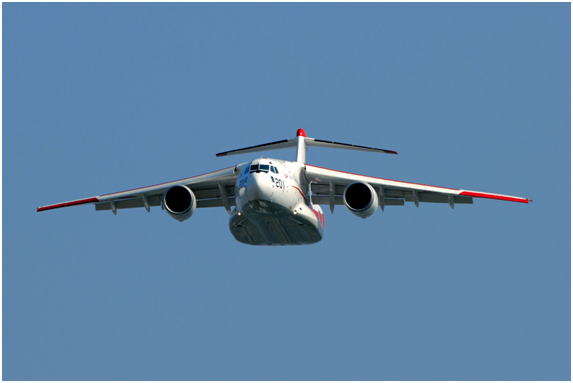
Here are more photos of my favorite Kawasaki XC-2 aircraft.
Photo Credit: Technical Research and Development Institute, Ministry of Defense, Japan




Sunday, June 19, 2011
(AFP) U.S. Senate Moves to Freeze Japan Base Move - Defense News
U.S. Senate Moves to Freeze Japan Base Move - Defense News
AGENCE FRANCE-PRESSE
Published: 18 Jun 2011 11:21
WASHINGTON - U.S. senators said June 17 that they have taken a major step to halt a controversial military base plan on Japan's Okinawa Island and called on the Pentagon to make a fresh assessment.
Brushing aside insistence by the two governments that plans should go ahead, the Senate Armed Services Committee agreed to bar any funds to move troops from Japan to Guam and ordered a new study on Okinawa's flashpoint Futenma base.
The language was part of an annual defense funding act approved June 16.
It needs approval from the full Senate and House of Representatives, but senators involved said that their actions on Asian bases enjoyed broad support.
Sen. Carl Levin, a member of President Barack Obama's Democratic Party who heads the committee, said that the base plan in Japan increasingly appeared unfeasible and that the United States needed to control costs.
"This is a major step to put all these changes on hold and to require some analysis of cost and to take an honest look at what the current plans are and what the alternatives are," Levin told reporters on a conference call.
The Senate intervened even though the Obama administration had put its foot down with Japan, insisting that the base plan could not be changed. One Japanese prime minister, Yukio Hatoyama, resigned last year after failing to fulfill campaign promises to come up with a new plan on the Futenma base.
"I think people have kind of hidden their heads in the sand because everyone just says, 'We've got a plan, we're going to keep going.' But the problem is the current plan isn't affordable, it's not workable," Levin said.
Okinawa is home to around half of the 47,000 U.S. troops stationed in Japan under a post-World War II security treaty. Futenma, a Marine Corps air station, is a particular source of grievance as it lies in what has become a crowded urban area.
Under a 2006 plan first approved by President George W. Bush's administration and a previous conservative government in Japan, the United States would close Futenma and move its aircraft to an isolated beach elsewhere in Okinawa. Some 8,000 Marines would leave Okinawa for Guam, a U.S. territory, in 2014.
The Senate bill prohibits funds for the Marine move until commanders provide an updated plan for Guam - where public support has been dwindling - and the Defense Department certifies "tangible progress" on the Futenma riddle.
Amid a push by lawmakers to tame a soaring debt, the Senate committee also cut $150 million during the year starting in October for projects linked to the shift to Guam.
The bill requires the Defense Department to study an alternative, drafted by Democratic Sen. Jim Webb of Virginia, to close and return Futenma's real estate and move its air assets to Okinawa's existing Kadena Air Base.
Under Webb's proposal, some air assets would be moved from Kadena to other parts of Japan and Guam - a solution he argued would reduce both congestion and costs.
"These recommendations are workable, cost-effective, will reduce the burden on the Okinawan people and will strengthen the American contribution to the security of the region," Webb, a former combat Marine who heads a subcommittee on East Asia, said in a statement.
In South Korea, the Senate bill would end funding obligations for troops to bring their families. Starting in 2007, military commanders have allowed many of the 28,500 troops stationed in South Korea to be accompanied.
A recent study by the non-partisan Government Accountability Office said that the Defense Department did not sufficiently study the costs of the change, which could total $22 billion through 2050.
The Senate bill does not freeze the overall base shift in South Korea, as initially proposed by Webb, Levin and Republican Sen. John McCain who voiced concern about mounting costs.
The U.S. military plans to start shifting next year to a base in the city of Pyeongtaek, eventually closing the huge Yongsan base in Seoul which was set up for the 1950-53 Korean War but now lies in the heart of a bustling metropolis.
Friday, June 10, 2011
My latest stories for Jane's Defence Weekly
ASIA PACIFIC
Date Posted: 09-Jun-2011
Jane's Defence Weekly
Japan keeps eye on PLAN flotilla as it passes Okinawa
Kosuke Takahashi
JDW Correspondent
Tokyo
The Japanese Ministry of Defence (MoD) said that 11 Chinese naval vessels sailed through international waters
between the islands of Okinawa and Miyako on 8-9 June: the largest flotilla of Chinese warships seen passing in the area.
According to the MoD, the People's Liberation Army Navy (PLAN) ships, including four frigates and three Russian built Sovremenny-class guided-missile destroyers, were observed by the Japan Maritime Self-Defence Force (JMSDF) over a two-day period. The presence of a submarine rescue ship suggests that submarines were also part of the flotilla, but this was not confirmed.
General Ryoichi Oriki, Chief of the Japan Self-Defence Force (JSDF) Joint Staff, said the JSDF would continue to monitor the PLAN's intensifying activities in waters off Japan.
On 9 June the Chinese Ministry of Defence said a PLAN fleet would conduct exercises in the west Pacific in mid-tolate June. "This will be a regular drill according to the [PLA's] annual plan," the ministry statement said.
Copyright © IHS Global Limited, 2011
ASIA PACIFIC
Date Posted: 09-Jun-2011
Jane's Defence Weekly
Marines to station Ospreys at Futenma
Kosuke Takahashi
JDW Correspondent
Tokyo
The US Department of Defense (DoD) said it plans to station the MV-22 Osprey at the controversial US Marine Corps air station at Futenma in Okinawa Prefecture, Japan, from late 2012 as part of an ongoing replacement of its ageing CH-46 Sea Knight helicopter fleet.
"The Marine Corps is in the process of phasing out the CH-46 and replacing it with the MV-22," Pentagon spokesman Colonel Dave Lapan said in a 6 June statement. "This process is beginning with units based at CONUS [continental US] air stations."
Japanese Defence Minister Toshimi Kitazawa said on 7 June he would visit Okinawa to explain the US plan to Okinawa Governor Hirokazu Nakaima.
Okinawans have opposed the deployment of Ospreys at Futenma, which is located in a densely populated part of Ginowan City, citing concerns about safety and noise pollution of the MV-22: a tilt-rotor vertical take-off and landing (VTOL) transport aircraft. During its development the Osprey suffered a series of accidents.
Futenma is due to close in 2014 under plans agreed in 2006 by the US and Japanese governments. However, this schedule is unlikely to be realised due to continuing disagreement about the marines' new home.
"According to the current USMC Aviation Plan, the MV-22 will replace the CH-46 within III MEF [Marine Expeditionary Force] in late 2012," Lapan said. "We have recently begun discussing the mechanics of the notification process involved with introducing this important Alliance capability to Okinawa.
"In comparison to the CH-46, the MV-22 is even safer, generally quieter and considerably more capable," he said.
Date Posted: 09-Jun-2011
Jane's Defence Weekly
Japan keeps eye on PLAN flotilla as it passes Okinawa
Kosuke Takahashi
JDW Correspondent
Tokyo
The Japanese Ministry of Defence (MoD) said that 11 Chinese naval vessels sailed through international waters
between the islands of Okinawa and Miyako on 8-9 June: the largest flotilla of Chinese warships seen passing in the area.
According to the MoD, the People's Liberation Army Navy (PLAN) ships, including four frigates and three Russian built Sovremenny-class guided-missile destroyers, were observed by the Japan Maritime Self-Defence Force (JMSDF) over a two-day period. The presence of a submarine rescue ship suggests that submarines were also part of the flotilla, but this was not confirmed.
General Ryoichi Oriki, Chief of the Japan Self-Defence Force (JSDF) Joint Staff, said the JSDF would continue to monitor the PLAN's intensifying activities in waters off Japan.
On 9 June the Chinese Ministry of Defence said a PLAN fleet would conduct exercises in the west Pacific in mid-tolate June. "This will be a regular drill according to the [PLA's] annual plan," the ministry statement said.
Copyright © IHS Global Limited, 2011
ASIA PACIFIC
Date Posted: 09-Jun-2011
Jane's Defence Weekly
Marines to station Ospreys at Futenma
Kosuke Takahashi
JDW Correspondent
Tokyo
The US Department of Defense (DoD) said it plans to station the MV-22 Osprey at the controversial US Marine Corps air station at Futenma in Okinawa Prefecture, Japan, from late 2012 as part of an ongoing replacement of its ageing CH-46 Sea Knight helicopter fleet.
"The Marine Corps is in the process of phasing out the CH-46 and replacing it with the MV-22," Pentagon spokesman Colonel Dave Lapan said in a 6 June statement. "This process is beginning with units based at CONUS [continental US] air stations."
Japanese Defence Minister Toshimi Kitazawa said on 7 June he would visit Okinawa to explain the US plan to Okinawa Governor Hirokazu Nakaima.
Okinawans have opposed the deployment of Ospreys at Futenma, which is located in a densely populated part of Ginowan City, citing concerns about safety and noise pollution of the MV-22: a tilt-rotor vertical take-off and landing (VTOL) transport aircraft. During its development the Osprey suffered a series of accidents.
Futenma is due to close in 2014 under plans agreed in 2006 by the US and Japanese governments. However, this schedule is unlikely to be realised due to continuing disagreement about the marines' new home.
"According to the current USMC Aviation Plan, the MV-22 will replace the CH-46 within III MEF [Marine Expeditionary Force] in late 2012," Lapan said. "We have recently begun discussing the mechanics of the notification process involved with introducing this important Alliance capability to Okinawa.
"In comparison to the CH-46, the MV-22 is even safer, generally quieter and considerably more capable," he said.
Friday, May 20, 2011
(My latest story for Asia Times Online) Futenma: Time on Okinawa's side
Futenma: Time on Okinawa's side
Pressure is rising on Washington over its plans to build a new United States military base on Okinawa, with influential senators proposing that for budgetary reasons the controversial Futenma marine base instead be integrated into an existing facility. While neither plan is favored by Okinawans, the US insists it needs to maintain a forward presence in the region. - Kosuke Takahashi (May 20, '11)
Futenma: Time on Okinawa's side
By Kosuke Takahashi
TOKYO - If you've been listening, Okinawans have for years been sounding an alarm over the presence of huge United States military bases on their island. Finally, key American legislators are coming round to their point of view, with both the US and Japan's ballooning budget deficits raising doubts over the current US base relocation plan.
Time is on Okinawa's side for sure.
Three influential senior US senators last week condemned the planned relocation of US Marine Corps Air Station (MCAS) Futenma to a new offshore base to be built on the same island as "unrealistic" and instead proposed integrating it into the nearby US Kadena Air Base.
The existing US-Japanese plan was criticized in a May 11 joint statement by Carl Levin, a Michigan Democrat and chairman of the Senate Arms Services Committee; Jim Webb, a Virginia Democrat and chairman of the committee's personnel subcommittee; and John McCain, the committee's ranking member and the 2008 Republican presidential candidate. The committee has influential power and authority on legislation and expenditure regarding the US military.
They also called for a delay in the realignment of US military forces in South Korea, pending a further review, and a reduction in the Marine Corps presence on Guam by rotating combat units that are home-based elsewhere.
"The proposals would save billions in taxpayer dollars, keep US military forces in the region, greatly reduce the timing of sensitive political issues surrounding MCAS Futenma and reduce the American footprint on Okinawa," the senators' joint statement said.
Levin said the enormous financial burden imposed on Japan by the disastrous March 11 earthquake and tsunami "also must be considered".
The relocation of the Futenma base has been deadlocked for more than a decade due to strong local opposition. The US had demanded that the transfer of around 8,000 Okinawa-based Marines to Guam would not occur unless the heliport functions of the Futenma base are moved by 2014 to a coastal area off the Marines' Camp Schwab in Nago City, northern Okinawa - as agreed in a 2006 bilateral pact with Japan.
But last September the US Department of Defense (DoD) unilaterally announced it would postpone completion of the transfer originally planned for 2014 due to Guam's poor preparedness on infrastructure, as it cannot accept the sudden influx of 8,000 Marines, their 9,000 dependents and construction workers.
Webb, a former US Marine who's visited Okinawa many times, said on his website that the US "DoD should immediately examine the feasibility of moving the Marine Corps assets at Futenma into Kadena Air Force Base, while dispersing a percentage of air force assets now at Kadena into other areas of the Pacific region."
James Jones, US President Barack Obama's former national security advisor, has also repeatedly said the consolidation of Futenma and Kadena bases would be the best option.
Why now?
What led three veteran US senators to reconsider the existing plan? In a whirlwind of international politics, domestic politics matters most. The Obama administration has to overcome mounting political and economical difficulties for a number of domestic issues in the coming months.
First, it needs to firmly proceed to trim the fat off the spending budget, especially on the military, which accounts for about two-thirds of the discretionary federal budget. The US government projects its financial deficit will exceed $1 trillion for four consecutive years in the fiscal year 2012 starting October as it continues to run at the highest level in history.
As the budgetary assessment for 2012 starts this month, US legislators are seeking any room for budgetary spending cuts.
There has been strong criticism against the current relocation plan, which calls for spending of more than $10 billion in Japanese and US funding, with Japan paying 60% and the US bearing the rest. Many experts expect that planning on Guam's military buildup is constantly shifting and the overall price tag will likely rise, as almost always happens in military spending.
Admiral Mike Mullen, chairman of the Joint Chiefs of Staff, has warned against the rising financial deficit, saying that "the biggest threat we have to our national security is our debt". This illustrates the seriousness of the US financial situation.
Second, the senators' appeal came shortly before US Defense Secretary Robert Gates is expected to leave the Pentagon by June 30, to be replaced by Central Intelligence Agency director Leon Panetta. By taking advantage of the occasion of a change of defense chief, they appear to be urging a policy shift on US bases in East Asia. The killing of Osama bin Laden and the start of a US troop withdrawal from Afghanistan in July also give the US administration a break in the fight against terrorism. This, along with a new defense chief, may bring about a new US global strategy, including on US bases abroad.
Third, in the so-called two-plus-two security meeting between foreign and defense ministers in May 2010, the two nations agreed to decide the specific location and construction method for a Futenma replacement facility before the next two-plus-two meeting, which is scheduled to be held by the end of June this year. The senators urged both nations' officials to look at the reality of the endless political stalemate over the Okinawa base relocation issue.
Okinawans against Futenma consolidation
The initial Okinawan response to the integration plan involving Kadena was not so bad. Okinawa Governor Hirokazu Nakaima said the proposal could be considered if it resulted in less fighter aircraft traffic at Kadena, reduced noise and base functions and eased of the burden on local communities.
However, he has gradually cooled on the idea, stressing the problems of noise pollution and the crimes of certain US soldiers.
In late April, more than 22,000 residents around the Kadena base filed a lawsuit demanding a night-time flight ban and a combined 44.6 billion Japanese yen (US$540 million) in compensation from the Japanese government, arguing their health has been affected by aircraft noise. The number of plaintiffs accounts for about one third of Kadena Town and around one in every 70 Okinawans. This put pressure on the governor not to make any compromise with the US. The Kadena base occupies 83% of Kadena Town.
Japanese Defense Minister Toshimi Kitazawa said on Thursday it will be "physically difficult" for Japan to comply with its agreement with the US to complete the planned relocation of the Futenma base by 2014 within Okinawa.
"The 2006 road map calls for the completion of a replacement facility for Futenma by 2014, but 2014 is just in front of our eyes," Kitazawa told the House of Representatives Committee on Security. "The Japanese government and Okinawa have not reached a deal," he said, referring to the strong local opposition.
He pointed out Guam's lack of infrastructure, which could also delay the original relocation plan, and he proposed that the two nations frankly discuss how to proceed with the deadlocked plan at the two-plus-two security meeting scheduled to be held in late June.
The initial Pentagon response was not encouraging for those who hope the senators' intervention may change US policy.
"We appreciate the perspectives of the senators, but the press release does not change our commitment to current plans to maintain a forward presence in the region that is geographically distributed, operationally resilient, and politically sustainable," Pentagon spokesperson Leslie Hull-Ryde told Asia Times Online.
"Current agreements and policies have been carefully developed over many years in close consultation and coordination with our allies and within the US government, including with the military services and with congress," she said. "This release does not change our commitment to our current approach."
Talk of the consolidation of the Futenma and Kadena bases has disappeared every time it has arisen in the past. To make it a politically feasible solution, the US needs to reduce the prospect of noise pollution. More importantly, as the US and Chinese militaries begin to recognize the necessity of working together, perhaps Japan and the US should be reconsidering the entire raison d'etre of massive US bases in Okinawa.
Kosuke Takahashi is a Tokyo-based Japanese journalist. His twitter is @TakahashiKosuke
(Copyright 2011 Asia Times Online (Holdings) Ltd. All rights reserved. Please contact us about sales, syndication and republishing.)
Tuesday, May 17, 2011
My latest stories for Jane's Defence Weekly
Here are my latest stories for JDW. I wrote about recent proposal by three influential US senators to integrate the Futenma base into Kadena Air Base in Okinawa.
Just FYI. The Pentagon spokesperson Leslie Hull-Ryde gave me the following official comments.
"We appreciate the perspectives of the senators, but the press release does not change our commitment to current plans to maintain a forward presence in the region that is geographically distributed, operationally resilient, and politically sustainable. "
"Current agreements and policies have been carefully developed over many years in close consultation and coordination with our allies and within the U.S. government, including with the military services and with Congress. This release does not change our commitment to our current approach. "
Senior US senators call for Futenma rethink
Japan draws down troops involved in tsunami relief effort
Japan, US conduct third major search for missing tsunami victims
Sunday, May 15, 2011
Japan Focus: Economic Crisis Shakes US Forces Overseas: The Price of Base Expansion in Okinawa and Guam
This is a very impressive story. I'd sure like my American friends to read this.
Japan Focus
Cheers, Kosuke
Economic Crisis Shakes US Forces Overseas: The Price of Base Expansion in Okinawa and Guam
By Yonamine Michiyo
Translated by Rumi Sakamoto and Matthew Allen
‘Debt is the Largest Threat’
On August 31, President Obama delivered a speech from the White House. Because he was expected to declare the end of the Iraqi war, the entire nation focused its attention on the content to the speech. ‘Operation Iraqi Freedom is over. … We have spent over a trillion dollars on this war, often financed by borrowing from overseas. This, in turn, has short-changed investments in our own people, and contributed to record deficits.... Our most urgent task is to restore our economy, and put the millions of Americans who have lost their jobs back to work’. It marked the beginning of a new era, and under other circumstances this speech would have impressed people. The president, however looked troubled, and the atmosphere was gloomy – hardly the context for a forward-looking policy announcement; this was largely due to the severity of the economic crisis the US currently faces.
The US financial deficit has exceeded one trillion dollars for two consecutive years and continues to run at the highest level in history. The unemployment rate is around 9%, with the most recent figure (November) being 9.8%, up 0.2 percentage points over the previous month. There were 143 bankrupted financial institutions in November, a significant increase over the previous year. There is no sign of improvement. Rebuilding the nation’s financial system is the top US priority.
In these difficult times, criticism of the massive military budget, which currently accounts for about two thirds of the discretionary federal budget has been publicly aired for the first time.
It is understandable that people are criticising military spending, which has increased year after year since the end of World War II, yet had been considered ‘inviolable’ in budget discussions. This year, though, Admiral Mike Mullen, chairman of the Joint Chiefs of Staff, warned against increasing the financial deficit, stating that ‘the biggest threat we have to our national security is our debt.’ In short, a senior US military leader has publicly declared that the biggest threat faced by the US is neither Iraq nor North Korea but the ‘debt of the state’. This illustrates the urgency of US state finances.
In Washington, more voices are demanding cuts in military spending. In May, a non-partisan group of congressional representatives, convened by Democrat Barney Frank, and Republican Ron Paul, formed the ‘Sustainable Defense Task Force’ (SDTF). Together with some military specialists, they closely scrutinised military spending and concluded that it was possible to cut 1 trillion dollars in spending over the next 10 years by reducing US Forces stationed in Europe and Asia, and by not pursuing contracts for military airplanes such as the MV-22 Osprey.
In October 57 congressional representatives from ruling and opposition parties who advocate cuts in military spending sent a letter to the National Commission on Fiscal Responsibility and Reform (NCFRR). It asked: ‘Why does the US continue to station troops overseas in Asia and Europe despite the collapse of the Cold War?’ and argued that national defense needs to reflect the new era. The NCFRR is an advisory body created by president Obama to identify strategies for rebuilding the economy. The non-partisan group asked this committee to reconsider the scale of military spending and the status of US Forces.
The view that the US is the policemen of the world is outdated; it is a leftover from the Cold War. 15,000 Marines aren’t going to land on the Chinese mainland and confront millions of Chinese soldiers. We don’t need Marines in Okinawa. They’re a hangover from a war that ended 65 years ago.
As Chairman of the House Financial Services Committee he was the driving force behind the Financial Regulatory Reform Act that passed Congress in 2010. This act is referred to as the Dodd-Frank Act. Ron Paul, a fellow member of the SDTF, is known as an isolationist who advocates withdrawal of US Forces overseas. He is a nationally known congressman who became well known during the 2008 presidential election.
In July, Frank and Paul wrote an article ‘Why We Must Reduce Military Spending’ for the Huffington Post, the influential political website. In it they explained that 2010 military spending was about $693 billion, over 42% of total government spending, and this is damaging the US economy and reducing people’s quality of life. They also pointed out that US intervention in other countries as a superpower often generates anger directed at the US, and concluded that ‘rebuilding our economy and creating jobs remains the nation’s top priority. It is essential that we begin to address the issue of excessive military spending.’ In confronting this national crisis, two people from different sides of the political spectrum are thus cooperating in urging reform.
In response to the letter from Frank et al., the NCFRR produced a chairman’s draft proposal in November. They recommended one trillion dollar cuts in defense spending by FY2015. The recommendation included reduction of military personnel stationed at bases in Europe and Asia by one-third, and ending procurement of the MV-22 Osprey – a combat assault transport for the Marines – which is projected to be based at the replacement facility for Futenma Air Station. Although the detailed list of military expenditure items was removed from the committee’s final report released on December 1, the report strongly advocated cuts in defense spending: ‘No exceptions. We must end redundant, wasteful, and ineffective federal spending – including defense’. This proposal, which incorporated reduction of the budget including tax overhaul, lacked the votes for approval in the voting two days later. However, it was put forward as a blueprint for public discussion, and brought to light the inevitability of drastic measures to reform national defense spending.
Similarly, a significant non-aligned, non-profit think tank, the Bipartisan Policy Centre, founded by Senators Dole, Mitchell, Baker, and Daschle, in November also called for a freeze on defense spending. Another think tank specialising in national security, ‘The Stimson Center’, has also published an article entitled ‘Choosing Defense Mission Priorities,’ which proposed cuts in the defense budget and called for the reduction of US military bases overseas. These and other organisations propose cuts in military spending and stress the necessity for a ruthless examination of the purpose and use of military spending–a view shared by ordinary citizens.
Reform Trends in a Military Environment
With all this pressure, not even the DoD can ignore the criticism. Defense Secretary Gates has announced $100 billion budget cuts over the next five years by reducing DoD personnel, slimming the organisation and reducing contract figures. On top of this, they are also re-examining the role of the military, in particular the Marine Corps, which in recent wars in Iraq and Afghanistan, has become a ‘second land army’. The Marines are known as an ‘expeditionary force in readiness’ and are characterised by their high mobility and ability to invade shorelines rapidly. However, recently they have been entering foreign lands on military airplanes, fighting on the ground, heavily armed, and deviating from their original purpose. The Marine Corps has become too large and the cost continues to increase.
Concerned with this situation, Gates in his speech to the Army in May asked, ‘What makes the role of the Marines different from that of the Army?’ The last amphibious landing was at Inchon during the Korean War. He explained that since then, for 60 years, there has been no Marine amphibious expedition.
Subsequently, in a lecture delivered in August, Gates revealed that he had ordered the leaders of the Navy and Marine Corps to review the mission of the Marines, including expeditionary forces, in the context of changing global threats and new technologies.
If defense spending is curtailed, the arms industry will suffer. Sensing the coming change, the industry has mobilised quickly. Lockheed Martin, the world’s largest defense manufacturer, with its main office in Washington state, recently offered its employees voluntary redundancy packages, and more than 600 employees, or 25% of the targeted employees, rushed to take the option. With Lockheed Martin leading the way, the arms industry is now engaged in restructuring; cutting the work-force; rationalising the workplace through incorporating units, abolishing redundant sectors; and canceling large projects.
At the same time, because the reduction in the scope of the military industrial sector and cost-cutting measures applied across the board mean reduced employment, some regions with no other large companies have objected. Congressional representatives from such regions have opposed the cuts, and both supporters and opponents are jockeying to influence decisions about the military’s future. Since summer, the move towards reduction of military spending has been widely reported in the US media. The Financial Times has also taken up the US defense environment on its front and analysis pages. Military spending has become an economic issue.
For the first time, serious discussion is about to take place concerning military spending, which rapidly increased since 9/11 with no questions asked; this discussion will also address the role of the military, with special emphasis placed on the significance of overseas Forces. A reform hurricane is brewing!
Diverse Opinions in the US
While questions are raised in Washington on the roles of Marines, US and Japanese governments are proceeding with plans to build new USMC facilities in Northern Okinawa.
I have explained the situation in the US at some length because this reform trend can affect other parts of the world that host US Forces overseas. It is therefore highly relevant to Japan, where many US troops are stationed. The most pressing base problem in Japan is Futenma Air Base. Both Japanese and US governments are still hewing to the principle of relocation to Henoko in Nago City. Many Japanese may think that the US must be irritated by the slow progress on the relocation. Besides, there is no way that the US bases will leave Okinawa. However, as the US itself re-examines many problems associated with military costs, adhering to the old framework means that we might miss the significance of this new trend. In fact, the overwhelming majority of American scholars and experts I interviewed believed that it was impossible to relocate to Henoko, and that the Marine Corps in Okinawa no longer plays any role in US military strategies. Such voices have become more strident since the beginning of this year. Let me introduce some of these voices below.
Mike Mochizuki (Professor, George Washington University):
I do not think that the Henoko relocation is practicable because gaining support of the democratically elected governor is crucial. The US government’s perspective is unrealistic. None of my American friends who specialise in Japan-US relations believe the agreement to relocate the bases will be carried out. [..] What does it (the Marines in Okinawa) deter? If it’s North Korea, there is the Korean Army. US Forces are stationed there, too. If the Futenma problem is going to weaken Japan-US relations, then even if the military presence is maintained, deterrence will be weak, because deterrence involves political elements as well. Nor do I believe that the Marines are in Okinawa to anticipate and resist an attack by China. I do recognize the importance of the Marines for humanitarian support, disaster relief and other emergency rescue operations. To perform those roles, however, it is possible to transport Marines from Camp Pendleton (in California) – there is no need to station them in Okinawa. Japan itself can provide rescue support logistics, too.
Morton Halperin, a former Deputy Assistant Secretary of Defense, who was involved in the 1972 negotiations over the return of Okinawa said:
I am quite surprised that after many decades since Okinawa’s reversion, the structure of the bases has not changed at all. This is because of government inaction. We need to pay attention to the burden on Okinawa. I visited Okinawa in 1968, and observed almost all the islands from a helicopter. My impression of Okinawa was that it was ‘empty’ because residents were concentrated in small areas. The rest was all bases. I asked a high ranking Navy officer, “Why do we have bases in Okinawa?” He answered, looking very serious, “You misunderstand. The military doesn’t have bases in Okinawa. The island itself is the base.” It was no exaggeration; the military really did think of the whole island as a base. The military intended to maintain Okinawa until there were no more disputes in Asia – that is, they planned to keep the bases forever. The structure of the bases in Okinawa is based on the assumption that Okinawa is a base and will continue to be a base forever. The US put bases on the mainland, too; but they were aware that it was Japanese territory. If they had an awareness that Okinawa was not a base but Japanese territory, they would have been able to ask themselves what sort of structure the base should have. But they are still not thinking about this seriously.
Richard Samuels, a prominent Professor of Japanese Politics at MIT followed a similar line:
The US needs to realise the political difficulty of Okinawa and consider training the helicopter units in other places like Guam. Futenma needs to be closed down as soon as possible. If there is any victim, the government’s forbearance will become an issue. It is time for the US to step back and consider a Plan B such as training in Guam, San Diego or Hawaii. We need to change direction. For that we need political leadership. [..] We can apply pressure through US negotiations with Japan. The Democratic Party of Japan wants an “equal Japan-US alliance”. If Japan can become more responsible towards the US and can say no, that would be an ideal alliance relationship. Germany sometimes says no, and France always does; this does not end the alliance. This is an honest and healthy relationship. The US always demands and Japan always says “yes”. The US should realise that Japan has lost its sense of self-governance. If the two countries do not share an understanding of the importance of their roles, the cost and benefit of their alliance, that is not a healthy relationship. Okinawa is disproportionately bearing the burden of security. It is possible to ask to lighten such a burden. Japanese people need to understand what a real burden means.
Professor Barry Posen, a specialist in Security Studies at MIT also supports this line of argument:
Even if the Marine Corps left Okinawa, if the Air Force and the Navy were to stay in Kadena and mainland Japan, there would be no change in deterrence. I cannot see what role the Marine Corps might play in military actions that are likely to take place in the context of Japan-China or China-Taiwan relations. I have heard that the Marines have tasks to perform in case of emergency on the Korean Peninsula; however, considering the size of today’s Korean military and their technological capabilities, it is not possible that the defense of Korea relies on a single US Marine force. [..] Of the three US Marine Corps divisions, the Okinawa division is the weakest in terms of combat strength. [..] In the plan to relocate parts of Futenma’s capacity to Guam, the Marine Corps in Okinawa will be divided into two (command unit and combat unit): it will take some time to coordinate the two units to act together; rather than wasting time in logistics it would be much less time-consuming if the whole division is withdrawn from Okinawa. [..] The US is maintaining too many bases and military forces overseas. We need to reduce them.
Professor Andrew Bacevich, Boston University (and a former US Army Colonel) had similar views:
Those in Washington believe that forward deployment of military forces will promote stability of the region. This may be true to some extent, but at the same time, overseas forces also contribute to regional instability. DoD consistently insists that the existing bases are strategically irreplaceable. Today’s Marine Corps, too, would say that Okinawa is strategically vital. But in reality, US forces have already given up some overseas bases and have managed to find ways of adapting to such losses. The US used to maintain two large bases in the Philippines – Subic Naval Base and Clark Air Base. Despite strong local opposition, the DoD used to insist that they were ‘important, irreplaceable bases.’ However, after the 1991 eruption of Mr. Pinatubo, when the bases were destroyed by the ashes, the US military decided that the cost of repairs would be too high and simply withdrew the forces. The argument that they were irreplaceable had suddenly vanished. [..] The mistake we Americans made after the end of the Cold War was our belief that military power is effective for solving problems. If the US were to adopt a low profile, including reduced military power, we could avoid a situation that leads to instability. Bureaucrats have too much faith in military power.
Listening to different people’s opinions from diverse fields in the US, it is clear that the US government’s explanations and policies do not necessarily have the support of the American people. In Japan, we still hear voices that extol the deterrence power of the Marine Corps in Okinawa; but we must change our thinking to fit changing times.
The US also has some domestic issues
Having said that, even the US government, which had been insensitive to Okinawan opposition, has finally begun to realise that it is difficult to implement the Japan-US agreement. When Governor Nakaima Hirokazu was re-elected in the November 28th Okinawa gubernatorial election, some US media reported that ‘the possibility of relocation has survived’, based on Nakaima’s previous acceptance of the relocation of Futenma Air Base to Henoko. However, Washington is not really that optimistic. Since before the election, Washington was less concerned about which candidate would win than about what measures the Japanese government might take in response to the election result.
On the day Nakaima’s projected victory became certain, the US State Department said that ‘Okinawan concerns will be reflected in the adjustment (of the U.S. military on Okinawa),” indicating that they were not going to take drastic measures. Crowley, the US Department of State spokesperson, said that ‘dialogue with Okinawa is the Japanese government’s job’, and Lapan, a DoD spokesperson, also avoided referring to Okinawa saying that it was a ‘domestic issue’. A senior US military officer in Japan said rather dispassionately, ‘we have already given them two options for runway layouts: V-shaped and I-shaped. We are waiting for the Japanese government’s decision’. They are all watching the Japanese government carefully. Unanimously calling Okinawa ‘Japan’s domestic issue’ may mean that the US government is already sensing an impasse around the Japan-US agreement and is preparing a contingency position.
The US domestic situation is also relevant. Given US plans to strengthen the bases on Guam, including transferring the Okinawa Marines there, it has no resources to spare to intervene in other countries. In September the DoD announced it would postpone completion of the transfer originally planned for 2014 due to lack of preparedness on Guam. The infrastructure cannot cope with the sudden influx of the Marines, their families and construction workers.
Prior to this, relevant congressional committees approved cutting the cost of relocation by 70 percent. With operations not progressing according to US government plan, the plan itself is now being questioned. Committee reports have severely criticised the government, stating: ‘Guam’s water and waste water facilities, electrical system, roads and other infrastructure are already inadequate. There is no consideration of the environment’ (US Senate Appropriations Committee); ‘It is a serious concern when and how the DoD will respond to the poor evaluation it received regarding the environmental impact of the Guam construction plan. They have not addressed its impact on residents either’ (House Committee on Appropriations).
Inadequate infrastructure and environmental concerns are not the only problems. Another issue is the construction of a Marine firing range for East Guam. The US military originally planned to construct the range inside the base, but in the 2008 plan it became clear that construction was to be outside the base. Part of the planned construction site was state-owned land. This land was originally meant to be allocated for landless Chamorros and descendents of those whose land was requisitioned by the US military after the war.
The Guam government in August sent a letter to the US Department of the Navy expressing concern over the new land acquisition that was to accompany the Marine relocation and the ‘move to extend the US bases on the island’. This was despite the original promise that the Marine relocation would involve no additional land acquisition or extension of military facilities. The Guam government’s position is to accept Marine relocation; but distrust is intensifying because of the discrepancy between the US government’s explanation to the locals and the actual plan. I visited Guam in April 2009 and spent one week gathering information; even then the firing range was a huge issue. The military has yet to satisfactorily answer questions about the situation.
The US military’s pattern of extending bases in accordance simply with their perceived military and strategic value, without any understanding of local circumstances, history and culture, is precisely what is happening in Okinawa. Regarding the construction of replacement facilities in Henoko, Japanese and US governments say that this is ‘not construction of a new base but relocation to the pre-existing Camp Schwab’; but since they are constructing runways where there was nothing before, extending the base in this way is the same as what is occurring on Guam. The US government’s argument that “the transfer to Guam is not progressing because the Futenma issue is stagnating” can no longer be accepted. This is a situation unique to the US. And if the delay is due to domestic circumstances in the US, packaging Guam with Futenma will not work. Four and a half years on since the 2006 announcement of the restructuring of US Forces, the agreement is coming apart at the seams.
Time to reconsider Futenma
As the US faces a financial crisis with no sign of recovery, and a number of difficult related issues, the trend of domestically-oriented policies and national consciousness will continue to accelerate. Even the Republican Party, which believes that a large defense budget is the barometer of state power, and which opposes defense budget cuts, has to accept that there is no such a thing as a ‘sacrosanct’ sector these days. If the inward-looking philosophy that ‘money should be spent only on our own country’ spreads further, overseas military forces will undoubtedly become a target to rationalise. Voices calling for ‘abolishing overseas forces’ have emerged even from within extremely conservative Tea Party groups that influenced recent midterm elections.
However, it would be premature to think that this will lead directly to the return of Futenma Air Base or the withdrawal of the Marines from Okinawa. Japan provides the world’s largest sympathy budget and is offering to construct a new US base in Henoko for free. In such favorable conditions, there is no need for the US to change things in Japan. In fact, in the public hearing of the House Armed Services Committee in July, Assistant Secretary of Defense Wallace Gregson flatly rejected committee members’ questions such as ‘Do the Marines need to be in Okinawa?’, by noting Okinawa’s geopolitical significance. He emphasised that ‘Japanese defense spending is only 1% of GDP. We would like to ask them to increase the sympathy budget’, thus turning the attention of Congress away from withdrawal towards the increase in the sympathy budget.
Regarding Okinawa’s geopolitical importance and the importance of the Marines stationed in Okinawa, the aforementioned scholars think that the Marines can be replaced with current military technologies or other, less specialised forces. Some people even question the necessity of the existence of Marines in Okinawa.
Peter Kuznick, a historian at American University says:
Japan is bearing substantial cost for US base relocation and maintenance. The US-Japan Mutual Security Treaty identified the purpose of US Forces in Japan as maintaining security in the Far East; but in reality they have turned into a military force that fights all over the world – Korea, Vietnam, the first Gulf War, Afghanistan, and Iraq.
He pointed out that the role of the US Forces in Japan has gone beyond the framework of a sympathy budget.
When the US government arrogantly tells us ‘we are protecting Japan; Japan should pay for it’, we may feel intimidated. But if we listen to various opinions outside the US government, we can clearly see that this is simply pressure that originates in self-righteousness. Naturally, diplomacy prioritizes national interest; there is no way that US diplomacy supports other countries, or Okinawa, for that matter.
But this also means that, in today’s situation concerning Japan and the US, the possibility exists that the prevailing logic is reversed. Namely, the US is short of funds. Cuts in military spending are inevitable. So is the review of forces overseas. The US Marines’ role needs to be reviewed. Marines in Okinawa are in a state of suspended animation. Okinawan people fiercely oppose relocation of Futenma Air Base to Henoko. The Prime Minister of an important allied nation was driven to resign over the US bases (Abe). US bases continue to be a huge political issue. As the US no longer has overwhelming power, and cannot do without the cooperation of its allies, it is not in US interest to continue pressing the base issue.
We often hear the threat that ‘if the Henoko relocation fails, Futenma will remain as is’; but it would take only one airplane crash to put the US government in a very difficult position. Closing down risky Futenma as soon as possible and restoring the unstable Japan-US relationship must surely suit US national interests. If Japan adheres to the existing logic – not to mention its Chief Cabinet Secretary asking Okinawa to accept the burden of the bases – Japan will not find a solution to the Futenma problem. It deserves to be criticised for its sycophantic diplomacy following the US. Fourteen years after the agreement to return Futenma base land to the people, with absolutlely no progress, the situation is ripe for change. If we link the new defense trends in the US with the ‘all-Okinawa’ opposition to relocation inside the prefecture, it is natural to conclude that it is time for reconsideration of the Futenma problem.
This is a slightly abbreviated version of an article that appeared in Sekai, February 2010.
Yonamine Michiyo (b.1966) was a journalist in Okinawa and Tokyo before being posted to Washington in 2010 as correspondent for the Ryukyu Shimpo. She is presently reporting from Okinawa.
Rumi Sakamoto is a senior lecturer in the School of Asian Studies, the University of Auckland, New Zealand, and a Japan Focus associate. Matt Allen is professor and head of the School of History and Politics, University of Wollongong, Australia, and a Japan Focus associate. Rumi and Matt are coeditors of Popular Culture, Globalization and Japan.
Recommended citation: Yonanime Michiyo, Economic Crisis Shakes US Forces Overseas: The Price of Base Expansion in Okinawa and Guam, The Asia-Pacific Journal Vol 9, Issue 9 No 2, February 28, 2011.
Friday, March 5, 2010
Okinawa and the new domino effect By John Feffer
Yesterday I just finished filing my tax return for the last year. I am very relieved now. This is a very big job for any freelance journalist in Japan. You need to support your tax return form by every single receipt, just in case the taxation authorities may examine your filing closely in the future.
Well, a lot of such precious taxes, including mine and yours, still go for military-related expenses in Japan, especially for US military bases! Here is a good story to think about it. Cheers, Kosuke
Okinawa and the new domino effect
By John Feffer
For a country with a pacifist constitution, Japan is bristling with weaponry. Indeed, that Asian land has long functioned as a huge aircraft carrier and naval base for United States military power. We couldn't have fought wars in Korea (1950-1953) and Vietnam (1959-1975) without the nearly 90 military bases scattered around the islands of our major Pacific ally. Even today, Japan remains the anchor of what's left of America's Cold War containment policy when it comes to China and North Korea. From the Yokota and Kadena air bases, the United States can dispatch troops and bombers across Asia, while the Yokosuka base near Tokyo is the largest American naval installation outside the United States.
You'd think that, with so many Japanese bases, the United States wouldn't make a big fuss about closing one of them. Think again. The current battle over the US Marine Corps air base at Futenma on Okinawa - an island prefecture almost 1,600 kilometers south of Tokyo that hosts about three dozen US bases and 75% of American forces in Japan - is just revving up. In fact, Washington seems ready to stake its reputation and its relationship with a new Japanese government on the fate of that base alone, which reveals much about US anxieties in the age of President Barack Obama.
What makes this so strange, on the surface, is that Futenma is an obsolete base. Under an agreement the George W Bush administration reached with the previous Japanese government, the US was already planning to move most of the Marines now at Futenma to the island of Guam. Nonetheless, the Obama administration is insisting, over the protests of Okinawans and the objections of Tokyo, on completing that agreement by building a new partial replacement base in a less heavily populated part of Okinawa.
The current row between Tokyo and Washington is no mere "Pacific squall", as Newsweek dismissively described it. After six decades of saying yes to everything the United States has demanded, Japan finally seems on the verge of saying no to something that matters greatly to Washington, and the relationship that Dwight D Eisenhower once called an "indestructible alliance" is displaying ever more hairline fractures. Worse yet, from the Pentagon's perspective, Japan's resistance might prove infectious - one major reason why the United States is putting its alliance on the line over the closing of a single antiquated military base and the building of another of dubious strategic value.
During the Cold War, the Pentagon worried that countries would fall like dominoes before a relentless communist advance. Today, the Pentagon worries about a different kind of domino effect. In Europe, North Atlantic Treaty Organization countries are refusing to throw their full support behind the US war in Afghanistan. In Africa, no country has stepped forward to host the headquarters of the Pentagon's new Africa Command. In Latin America, little Ecuador has kicked the US out of its air base in Manta.
All of these are undoubtedly symptoms of the decline in respect for American power that the US military is experiencing globally. But the current pushback in Japan is the surest sign yet that the American empire of overseas military bases has reached its high-water mark and will soon recede.
Toady no more?
Until recently, Japan was virtually a one-party state, and that suited Washington just fine. The long-ruling Liberal Democratic Party (LDP) had the coziest of bipartisan relations with that city's policymakers and its "chrysanthemum club" of Japan-friendly pundits. A recent revelation that, in 1969, Japan buckled to president Richard Nixon's demand that it secretly host US ships carrying nuclear weapons - despite Tokyo's supposedly firm anti-nuclear principles - has pulled back the curtain on only the tip of the toadyism.
During and after the Cold War, Japanese governments bent over backwards to give Washington whatever it wanted. When government restrictions on military exports got in the way of the alliance, Tokyo simply made an exception for the United States. When cooperation on missile defense contradicted Japan's ban on militarizing space, Tokyo again waved a magic wand and made the restriction disappear.
Although Japan's constitution renounces the "threat or the use of force as a means of settling international disputes", Washington pushed Tokyo to offset the costs of the US military adventure in the first Gulf War against Saddam Hussein in 1990-1991, and Tokyo did so. Then, from November 2001 until just recently, Washington persuaded the Japanese to provide refueling in the Indian Ocean for vessels and aircraft involved in the war in Afghanistan. In 2007, the Pentagon even tried to arm-twist Tokyo into raising its defense spending to pay for more of the costs of the alliance.
Of course, the LDP complied with such demands because they intersected so nicely with its own plans to bend that country's peace constitution and beef up its military. Over the last two decades, in fact, Japan has acquired remarkably sophisticated hardware, including fighter jets, in-air refueling capability, and assault ships that can function like aircraft carriers. It also amended the 1954 Self-Defense Forces Law, which defines what the Japanese military can and cannot do, more than 50 times to give its forces the capacity to act with striking offensive strength. Despite its "peace constitution", Japan now has one of the top militaries in the world.
Enter the Democratic Party of Japan (DPJ). In August 2009, that upstart political party dethroned the LDP, after more than a half-century in power, and swept into office with a broad mandate to shake things up. Given the country's nose-diving economy, the party's focus has been on domestic issues and cost-cutting. Not surprisingly, however, the quest to cut pork from the Japanese budget has led the party to scrutinize the alliance with the US. Unlike most other countries that host US military bases, Japan shoulders most of the cost of maintaining them: more than $4 billion per year in direct or indirect support.
Under the circumstances, the new government of Prime Minister Yukio Hatoyama proposed something modest indeed - putting the US-Japan alliance on, in the phrase of the moment, a "more equal" footing. It inaugurated this new approach in a largely symbolic way by ending Japan's resupply mission in the Indian Ocean (though Tokyo typically sweetened the pill by offering a five-year package of $5 billion in development assistance to the Afghan government).
More substantively, the Yukio Hatoyama government also signaled that it wanted to reduce its base-support payments. Japan's proposed belt-tightening comes at an inopportune moment for the Obama administration, as it tries to pay for two wars, its "overseas contingency operations", and a worldwide network of more than 700 military bases. The burdens of US overseas operations are increasing, and fewer countries are proving willing to share the costs.
Of dugongs and democracy
The immediate source of tension in the US-Japanese relationship has been Tokyo's desire to renegotiate that 2006 agreement to close Futenma, transfer those 8,000 Marines to Guam, and build a new base in Nago, a less densely populated area of the island. It's a deal that threatens to make an already strapped government pay big. Back in 2006, Tokyo promised to shell out more than $6 billion just to help relocate the Marines to Guam.
The political cost to the new government of going along with the LDP's folly may be even higher. After all, the DPJ received a healthy chunk of voter support from Okinawans, dissatisfied with the 2006 agreement and eager to see the American occupation of their island end. Over the last several decades, with US bases built cheek-by-jowl in the most heavily populated parts of the island, Okinawans have endured air, water, and noise pollution, accidents like a 2004 US helicopter crash at Okinawa International University, and crimes that range from trivial speeding violations all the way up to the rape of a 12-year-old girl by three Marines in 1995.
According to a June 2009 opinion poll, 68% of Okinawans opposed relocating Futenma within the prefecture, while only 18% favored the plan. Meanwhile, the Social Democratic Party, a junior member of the ruling coalition, has threatened to pull out if Hatoyama backs away from his campaign pledge not to build a new base in Okinawa.
Then there's the dugong, a sea mammal similar to the manatee that looks like a cross between a walrus and a dolphin and was the likely inspiration for the mermaid myth. Only 50 specimens of this endangered species are still living in the marine waters threatened by the proposed new base near less populated Nago. In a landmark case, Japanese lawyers and American environmentalists filed suit in US federal court to block the base's construction and save the dugong.
Realistically speaking, even if the Pentagon were willing to appeal the case all the way up to the Supreme Court, lawyers and environmentalists could wrap the US military in so much legal and bureaucratic red tape for so long that the new base might never leave the drawing board.
For environmental, political, and economic reasons, ditching the 2006 agreement is a no-brainer for Tokyo. Given Washington's insistence on retaining a base of little strategic importance, however, the challenge for the DPJ has been to find a site other than Nago. The Japanese government floated the idea of merging the Futenma facility with existing facilities at Kadena, another US base on the island. But that plan - as well as possible relocation to other parts of Japan - has met with stiff local resistance. A proposal to further expand facilities in Guam was nixed by the governor there.
The solution to all this is obvious: close down Futenma without opening another base. But so far, the US is refusing to make it easy for the Japanese. In fact, Washington is doing all it can to box the new government in Tokyo into a corner.
Ratcheting up the pressure
The US military presence in Okinawa is a residue of the Cold War and a US commitment to containing the only military power on the horizon that could threaten American military supremacy. Back in the 1990s, the Bill Clinton administration's solution to a rising China was to "integrate, but hedge". The hedge - against the possibility of China developing a serious mean streak - centered around a strengthened US-Japan alliance and a credible Japanese military deterrent.
What the Clinton administration and its successors didn't anticipate was how effectively and peacefully China would disarm this hedging strategy with careful statesmanship and a vigorous trade policy. A number of Southeast Asian countries, including the Philippines and Indonesia, succumbed early to China's version of checkbook diplomacy. Then, in the last decade, South Korea, like the Japanese today, started to talk about establishing "more equal" relations with the US in an effort to avoid being drawn into any future military scrape between Washington and Beijing.
Okinawa and the new domino effect
By John Feffer
Now, with its arch-conservatives gone from government, Japan is visibly warming to China's charms. In 2007, China had already surpassed the US as the country's leading trade partner. On becoming prime minister, Hatoyama sensibly proposed the future establishment of an East Asian community patterned on the European Union. As he saw it, that would leverage Japan's position between a rising China and a United States in decline. In December, while Washington and Tokyo were haggling bitterly over the Okinawa base issue, DPJ leader Ichiro Ozawa sent a signal to Washington as well as Beijing by shepherding a 143-member delegation of his party's legislators on a four-day trip to China.
Not surprisingly, China's bedazzlement policy has set off warning bells in Washington, where the People's Republic is still a focus
of primary concern for a cadre of strategic planners inside the Pentagon. The Futenma base - and its potential replacement - would be well situated, should Washington ever decide to send rapid response units to the Taiwan Strait, the South China Sea, or the Korean peninsula. Strategic planners in Washington like to speak of the "tyranny of distance", of the difficulty of getting "boots on the ground" from Guam or Hawaii in case of an East Asian emergency.
Yet the actual strategic value of Futenma is, at best, questionable. The South Koreans are more than capable of dealing with any contingency on the peninsula. And the United States frankly has plenty of firepower by air (Kadena) and sea (Yokosuka) within hailing distance of China. A couple thousand Marines won't make much of a difference (though the leathernecks strenuously disagree). However, in a political environment in which the Pentagon is finding itself making tough choices between funding counterinsurgency wars and old Cold War weapons systems, the "China threat" lobby doesn't want to give an inch.
Failure to relocate the Futenma base within Okinawa might be the first step down a slippery slope that could potentially put at risk billions of dollars in Cold War weapons still in the production line. It's hard to justify buying all the fancy toys without a place to play with them.
And that's one reason the Obama administration has gone to the mat to pressure Tokyo to adhere to the 2006 agreement. It even dispatched Secretary of Defense Robert Gates to the Japanese capital last October in advance of president Obama's own Asian tour. Like an impatient father admonishing an obstreperous teenager, Gates lectured the Japanese "to move on" and abide by the agreement - to the irritation of both the new government and the public. (See Gates gets grumpy in Tokyo, October 28, 2009)
The punditocracy has predictably closed ranks behind a bipartisan Washington consensus that the new Japanese government should become as accustomed to its junior status as its predecessor and stop making a fuss. The Obama administration is frustrated with "Hatoyama's amateurish handling of the issue," writes Washington Post editorial page editor Fred Hiatt. "What has resulted from Mr Hatoyama's failure to enunciate a clear strategy or action plan is the biggest political vacuum in over 50 years," adds Victor Cha, former director of Asian affairs at the National Security Council. Neither analyst acknowledges that Tokyo's only "failure" or "amateurish" move was to stand up to Washington. "The dispute could undermine security in East Asia on the 50th anniversary of an alliance that has served the region well," intoned The Economist more bluntly. "Tough as it is for Japan's new government, it needs to do most, though not all, of the caving in."
The Hatoyama government is by no means radical, nor is it anti-American. It isn't preparing to demand that all, or even many, US bases close. It isn't even preparing to close any of the other three dozen (or so) bases on Okinawa. Its modest pushback is confined to Futenma, where it finds itself between the rock of Japanese public opinion and the hard place of Pentagon pressure.
Those who prefer to achieve Washington's objectives with Japan in a more roundabout fashion counsel patience. "If America undercuts the new Japanese government and creates resentment among the Japanese public, then a victory on Futenma could prove Pyrrhic," writes Joseph Nye, the architect of US Asia policy during the Clinton years. Japan hands are urging the United States to wait until the summer, when the DPJ has a shot at picking up enough additional seats in the next parliamentary elections to jettison its coalition partners, if it deems such a move necessary.
Even if the Social Democratic Party is no longer in the government constantly raising the Okinawa base issue, the DPJ still must deal with democracy on the ground. The Okinawans are dead set against a new base. The residents of Nago, where that base would be built, just elected a mayor who campaigned on a no-base platform. It won't look good for the party that has finally brought real democracy to Tokyo to squelch it in Okinawa.
Reverse island hop
Wherever the US military puts down its foot overseas, movements have sprung up to protest the military, social, and environmental consequences of its military bases. This anti-base movement has notched some successes, such as the shut-down of a US navy facility in Vieques, Puerto Rico, in 2003. In the Pacific, too, the movement has made its mark. On the heels of the eruption of Mt Pinatubo, democracy activists in the Philippines successfully closed down the ash-covered Clark Air Force Base and Subic Bay Naval Station in 1991-1992. Later, South Korean activists managed to win closure of the huge Yongsan facility in downtown Seoul.
Of course, these were only partial victories. Washington subsequently negotiated a Visiting Forces Agreement with the Philippines, whereby the US military has redeployed troops and equipment to the island, and replaced Korea's Yongsan base with a new one in nearby Pyeongtaek. But these not-in-my-backyard (NIMBY) victories were significant enough to help edge the Pentagon toward the adoption of a military doctrine that emphasizes mobility over position. The US military now relies on "strategic flexibility" and "rapid response" both to counter unexpected threats and to deal with allied fickleness.
The Hatoyama government may indeed learn to say no to Washington over the Okinawa bases. Evidently considering this a likelihood, former deputy secretary of state and former US ambassador to Japan Richard Armitage has said that the United States "had better have a plan B". But the victory for the anti-base movement will still be only partial. US forces will remain in Japan, and especially Okinawa, and Tokyo will undoubtedly continue to pay for their maintenance.
Buoyed by even this partial victory, however, NIMBY movements are likely to grow in Japan and across the region, focusing on other Okinawa bases, bases on the Japanese mainland, and elsewhere in the Pacific, including Guam. Indeed, protests are already building in Guam against the projected expansion of Andersen Air Force Base and Naval Base Guam to accommodate those Marines from Okinawa. And this strikes terror in the hearts of Pentagon planners.
In World War II, the United States employed an island-hopping strategy to move ever closer to the Japanese mainland. Okinawa was the last island and last major battle of that campaign, and more people died during the fighting there than in the subsequent atomic bombings of Hiroshima and Nagasaki combined: 12,000 US troops, more than 100,000 Japanese soldiers, and perhaps 100,000 Okinawan civilians. This historical experience has stiffened the pacifist resolve of Okinawans.
The current battle over Okinawa again pits the United States against Japan, again with the Okinawans as victims. But there is a good chance that the Okinawans, like the Na'vi in that great NIMBY film Avatar, will win this time.
A victory in closing Futenma and preventing the construction of a new base might be the first step in a potential reverse island hop. NIMBY movements may someday finally push the US military out of Japan and off Okinawa. It's not likely to be a smooth process, nor is it likely to happen any time soon. But the kanji (a form of Japanese writing) is on the wall. Even if the Yankees don't know what the Japanese characters mean, they can at least tell in which direction the exit arrow is pointing.
John Feffer is the co-director of Foreign Policy in Focus at the Institute for Policy Studies and writes its regular World Beat column. His past essays, including those for TomDispatch.com, can be read at his website.
(Copyright 2010 John Feffer.)
(Used by permission Tomdispatch)
Subscribe to:
Posts (Atom)