| ASIA PACIFIC Date Posted: 19-Mar-2012 Japan threatens to shoot down North Korean rocketKosuke Takahashi JDW CorrespondentTokyo Additional reporting by James Hardy Asia-Pacific Editor London The warning came on 19 March from Japanese Defence Minister Naoki Tanaka, who said he would order the Japan Self-Defence Forces (SDF) to take action. "If we judge it poses a danger to Japan, I will take the necessary steps [to issue a destruction order]," Tanaka said during a Budget Committee session at the House of Councillors. 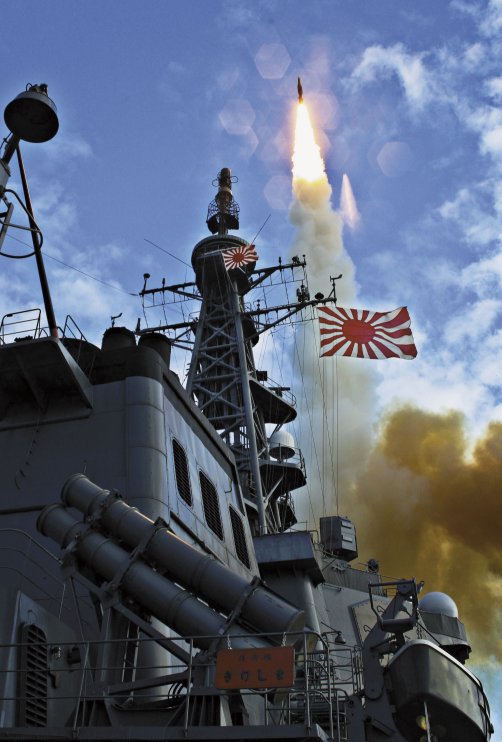 North Korea announced on 16 March that it would launch an Unha-3 rocket carrying an earth observation satellite called Kwangmyongsong-3 between 12 and 16 April, dates that coincide with celebrations for the 100th anniversary of the birth of regime founder Kim Il-sung. Japan's ballistic missile defence (BMD) system comprises 32 MIM-104F Patriot Advanced Capability-3 (PAC-3) missile interceptor batteries, in addition to batteries operated by US Forces Japan; four Kongo-class destroyers equipped with Standard SM-3 Block IA missiles; and two Atago-class destroyers equipped with the SM-2 Block IIIB system. Foreign Minister Koichiro Gemba said it was possible the North Korean missile could fly over the Nansei Islands, which include Okinawa Prefecture and stretch southwest towards Taiwan in the East China Sea. If Tanaka does issue a destruction order, he will be following a precedent set by then defence minister Yasukazu Hamada, who, on 27 March 2009, activated Japan's missile defence system in response to North Korean missile launch plans. On 5 April 2009 the North launched an Unha-2 rocket reportedly carrying a Kwangmyongsong-2 satellite from the Musudan-ni/Tonghae launch base in northeastern North Korea. However, Tokyo took no action because the rocket was deemed to pose no danger.
 |  |
Thursday, March 22, 2012
My latest story for JDW: Japan threatens to shoot down North Korean rocket

Friday, March 2, 2012
Asia Times Online :: Damage control, not the end of nukes
My latest story Asia Times Online :: Damage control, not the end of nukes
Damage control, not the end of nukes
By Kosuke Takahashi
TOKYO - Although the nuclear deal between North Korea and the United States may help defuse spiraling tensions in East Asia, it represents a harsh new reality: US nuclear diplomacy is unable to "end" North Korea's nuclear weapons program. Rather, it can only halt it.
With American foreign policy swamped with Iran, Syria, Afghanistan, Pakistan and elsewhere, the Barack Obama administration apparently aims to just "manage and control" the US relationship with North Korea - by keeping it from escalating out of control.
Experts expect North Korea's actions this time may pave the way for a resumption of the six-party talks, but the talks would be more aimed at arms control and disarmament of the Korean peninsula, rather than its denuclearization.
 "In recent years, senior US government officials have managed and controlled US relations with North Korea, rather than pursued an engagement policy," Young C Kim, professor emeritus of George Washington University, said at a recent forum in Tokyo. "It is problematic in that it tends to become a policy of tacit approval."
On Wednesday, Washington and Pyongyang announced that North Korea had agreed to implement a moratorium on long-range missile launches, nuclear tests, and nuclear activities at its Yongbyon research center including uranium enrichment activities, in return for US food aid.
But on the same day, key differences on the agreement emerged. The US said Pyongyang has agreed to monitoring of its plutonium program and uranium enrichment activities by the International Atomic Energy Agency(IAEA), while the North did not confirm this.
In any case, the US and South Korean intelligence agencies know there are other uranium enrichment facilities besides Yongbyon - North Korea only offered Yongbyon up as a concession while hiding other cards, in a classic salami-slice strategy.
A hungry child knows no politics
The US is to provide 240,000 tonnes of nutritional aid such as corn-soy blend, vegetable oil and therapeutic foods for children under the age of 6, pregnant women and elderly citizens to meet the North's urgent needs.
Interestingly enough, the tonnage of nutritional assistance is almost the same amount then Japanese prime minister Junichiro Koizumi offered in May 2004 in return for the family members of five former abductees by North Korea.
Pyongyang is no doubt desperate for food. A call made in a joint New Year's Day editorial by three major North Korean newspapers on January 1 that were considered Pyongyang's policy guidelines for the new year stressed increased efforts in the country to address food shortages, which it said are a ''burning issue in building a thriving country".
For the US, bilateral negotiations with North Korea on humanitarian assistance such as food aid, as well as on the hunt for the remains of soldiers missing-in-action from the Korean War, have been always possible even amid intensified tensions.
This is because the traditional US food aid policy is based on the slogan of "a hungry child knows no politics," as the late president Ronald Reagan said, although every famine is complicated by politics.
Buying time and putting off the inevitable
According to the Center for Strategic and International Studies (CSIS), the current consensus view in the Obama administration appears to be that the North Korean problem is best managed through diplomacy. A CSIS study shows that over the past 35 years, Pyongyang has not fired missiles or torpedoed ships when its diplomats are sitting at the table with Americans (with one exception in 1998).
Obama's personal mission to advocate "a world without nuclear weapons" is fading, especially when a nuclear Iran seems ever more imminent. But he needs to keep Pyongyang from conducting a third nuclear bomb test in the lead-up to the US presidential election due this November. The US may want to grasp an understanding for the newly born Kim Jong-eun's rule via bilateral talks and the six-party talks - involving the US, Japan, South and North Korea, China and Russia.
"Please note that the United States has long said that we will never accept North Korea as a nuclear power," Pentagon spokesperson Leslie Hull-Ryde told Asia Times Online.
For Pyongyang, all of the recent movements may be just dilatory efforts. Military experts expect the North would develop intercontinental ballistic missiles capable of carrying downsized nuclear warheads and reaching the US mainland, which would significantly strengthen the North's hand and deepen the security fears of regional rivals such as Japan and South Korea.
There is a widespread view among experts that Pyongyang will not and cannot abandon its nuclear and missile development, despite any compromises by the Obama administration as it eagerly seeks another foreign-policy success in this election year.
For young leader Kim Jong-eun, nuclear-tipped missiles are still the strongest weapon and best deterrent against regime collapse in the Hermit Kingdom. He will hang on to them by all means.
The existing six-party talks could be set aside and a foreign ministerial meeting be held among six nations "to discuss the issue of peace, security and economic cooperation," George Washington University's Kim said. "By way of that foreign ministerial meeting, bilateral talks between North Korea and the US, between South and North Koreas, and between Japan and North Korea, can be held."
Lee Jong Won, professor of International Politics at Rikkyo University, echoed Kim's views.
"Professor Kim's proposal is based on realism," Lee said. "Future six-party talks could be reclassified as 'disarmament' negotiations, rather than aiming at the denuclearization of the Korean peninsula. It would be more like Conference on Security and Cooperation in Europe, which adopted the Helsinki Declaration."
Kosuke Takahashi is a Tokyo-based Japanese journalist. His twitter is @TakahashiKosuke
(Copyright 2012 Asia Times Online (Holdings) Ltd. All rights reserved. Please contact us about sales, syndication and republishing.)
Damage control, not the end of nukes
By Kosuke Takahashi
TOKYO - Although the nuclear deal between North Korea and the United States may help defuse spiraling tensions in East Asia, it represents a harsh new reality: US nuclear diplomacy is unable to "end" North Korea's nuclear weapons program. Rather, it can only halt it.
With American foreign policy swamped with Iran, Syria, Afghanistan, Pakistan and elsewhere, the Barack Obama administration apparently aims to just "manage and control" the US relationship with North Korea - by keeping it from escalating out of control.
Experts expect North Korea's actions this time may pave the way for a resumption of the six-party talks, but the talks would be more aimed at arms control and disarmament of the Korean peninsula, rather than its denuclearization.
On Wednesday, Washington and Pyongyang announced that North Korea had agreed to implement a moratorium on long-range missile launches, nuclear tests, and nuclear activities at its Yongbyon research center including uranium enrichment activities, in return for US food aid.
But on the same day, key differences on the agreement emerged. The US said Pyongyang has agreed to monitoring of its plutonium program and uranium enrichment activities by the International Atomic Energy Agency(IAEA), while the North did not confirm this.
In any case, the US and South Korean intelligence agencies know there are other uranium enrichment facilities besides Yongbyon - North Korea only offered Yongbyon up as a concession while hiding other cards, in a classic salami-slice strategy.
A hungry child knows no politics
The US is to provide 240,000 tonnes of nutritional aid such as corn-soy blend, vegetable oil and therapeutic foods for children under the age of 6, pregnant women and elderly citizens to meet the North's urgent needs.
Interestingly enough, the tonnage of nutritional assistance is almost the same amount then Japanese prime minister Junichiro Koizumi offered in May 2004 in return for the family members of five former abductees by North Korea.
Pyongyang is no doubt desperate for food. A call made in a joint New Year's Day editorial by three major North Korean newspapers on January 1 that were considered Pyongyang's policy guidelines for the new year stressed increased efforts in the country to address food shortages, which it said are a ''burning issue in building a thriving country".
For the US, bilateral negotiations with North Korea on humanitarian assistance such as food aid, as well as on the hunt for the remains of soldiers missing-in-action from the Korean War, have been always possible even amid intensified tensions.
This is because the traditional US food aid policy is based on the slogan of "a hungry child knows no politics," as the late president Ronald Reagan said, although every famine is complicated by politics.
Buying time and putting off the inevitable
According to the Center for Strategic and International Studies (CSIS), the current consensus view in the Obama administration appears to be that the North Korean problem is best managed through diplomacy. A CSIS study shows that over the past 35 years, Pyongyang has not fired missiles or torpedoed ships when its diplomats are sitting at the table with Americans (with one exception in 1998).
Obama's personal mission to advocate "a world without nuclear weapons" is fading, especially when a nuclear Iran seems ever more imminent. But he needs to keep Pyongyang from conducting a third nuclear bomb test in the lead-up to the US presidential election due this November. The US may want to grasp an understanding for the newly born Kim Jong-eun's rule via bilateral talks and the six-party talks - involving the US, Japan, South and North Korea, China and Russia.
"Please note that the United States has long said that we will never accept North Korea as a nuclear power," Pentagon spokesperson Leslie Hull-Ryde told Asia Times Online.
For Pyongyang, all of the recent movements may be just dilatory efforts. Military experts expect the North would develop intercontinental ballistic missiles capable of carrying downsized nuclear warheads and reaching the US mainland, which would significantly strengthen the North's hand and deepen the security fears of regional rivals such as Japan and South Korea.
There is a widespread view among experts that Pyongyang will not and cannot abandon its nuclear and missile development, despite any compromises by the Obama administration as it eagerly seeks another foreign-policy success in this election year.
For young leader Kim Jong-eun, nuclear-tipped missiles are still the strongest weapon and best deterrent against regime collapse in the Hermit Kingdom. He will hang on to them by all means.
The existing six-party talks could be set aside and a foreign ministerial meeting be held among six nations "to discuss the issue of peace, security and economic cooperation," George Washington University's Kim said. "By way of that foreign ministerial meeting, bilateral talks between North Korea and the US, between South and North Koreas, and between Japan and North Korea, can be held."
Lee Jong Won, professor of International Politics at Rikkyo University, echoed Kim's views.
"Professor Kim's proposal is based on realism," Lee said. "Future six-party talks could be reclassified as 'disarmament' negotiations, rather than aiming at the denuclearization of the Korean peninsula. It would be more like Conference on Security and Cooperation in Europe, which adopted the Helsinki Declaration."
Kosuke Takahashi is a Tokyo-based Japanese journalist. His twitter is @TakahashiKosuke
(Copyright 2012 Asia Times Online (Holdings) Ltd. All rights reserved. Please contact us about sales, syndication and republishing.)
Friday, February 17, 2012
(My latest stories for JDW) Japan urges Israeli restraint over Iran
ASIA PACIFIC
Jane's Defence Weekly
Tokyo
Japanese Prime Minister Yoshihiko Noda has urged Israeli Defense Minister Ehud Barak not to attack Iran's nuclear facilities.
On 15 February Noda called on Barak, who was embarking on a five-day visit to Japan, to resolve the issue of Iran's nuclear programme "in a peaceful and diplomatic way" by stressing that military options would be dangerous and only aggravate the situation, according to a statement by Japan's Ministry of Foreign Affairs.
"A nuclear Iran is unacceptable, and Israel is determined to prevent it," Barak said on 16 February in a nationally broadcast interview with Japan's NHK television channel. "No options should be removed from the table."
Date Posted: 17-Feb-2012
Japan urges Israeli restraint over Iran
Kosuke Takahashi JDW CorrespondentTokyo
On 15 February Noda called on Barak, who was embarking on a five-day visit to Japan, to resolve the issue of Iran's nuclear programme "in a peaceful and diplomatic way" by stressing that military options would be dangerous and only aggravate the situation, according to a statement by Japan's Ministry of Foreign Affairs.
"A nuclear Iran is unacceptable, and Israel is determined to prevent it," Barak said on 16 February in a nationally broadcast interview with Japan's NHK television channel. "No options should be removed from the table."
| Copyright © IHS Global Limited, 2012 ASIA PACIFIC Date Posted: 10-Feb-2012 Update: Kawasaki loses AH-1S crash caseKosuke Takahashi JDW CorrespondentTokyo The Tokyo District Court ruled that the crash was caused by a manufacturing defect in an engine provided by the company. According to the ruling, a JGSDF Fuji-Bell AH-1S attack helicopter crashed from an altitude of around 75 m at the Higashi-Fuji manoeuvre area in Shizuoka Prefecture, seriously injuring two crew members. The judgement said that the AH-1S lost power after parts of the engine's fuel control system became detached as the helicopter was about to move forward from a stationary hover. This is the third major compensation suit between the MoD and a major Japanese defence company in recent years. In 2011 Toshiba sued the MoD for damages over the cancellation of contracts to remodel F-15J combat aircraft into reconnaissance platforms, while in 2009 Fuji Heavy Industries filed a suit against the MoD over its decision to reduce its order of AH-64D Apache attack helicopters from 62 to 13. "I am afraid more and more firms will withdraw from the defence business," said military analyst Shinichi Kiyotani. "Firms can no longer anticipate big profits and business risks are growing due to the ministry's strict stance towards industry [in the face of] a shrinking defence budget." This is an updated version of a story originally published on 3 February
|
Friday, February 10, 2012
(My latest story for Asia Times) Okinawans see duplicity in US withdrawal
Hello my friends. Here is my latest story for Asia Times Online.
If you get time, please go over this.
Good weekend!
Cheers,
Kosuke
Okinawans see duplicity in US withdrawal
By Kosuke Takahashi
TOKYO - With the United States shifting its axis of security toward the Asia-Pacific by expanding its military footprint in Australia, the Philippines and Vietnam, it may be high time for the United States Marine Corps to leave Japan's Okinawa.
A shifting security dynamic in the region, most notably due to China's enhanced strike capabilities, will likely marginalize the marines' presence on the island.
Japan and the US this week agreed to move about 4,700 marines from Okinawa to the US Pacific territory of Guam, while sticking to fiercely opposed plans to move US Marine Corps Air Station (MCAS) Futenma to a new offshore base to be built in a coastal area off Camp Schwab, another marine base in Nago City, northern Okinawa.

The shift to Guam is a departure from a previous 2006 bilateral agreement on the realignment of US forces in Japan. Until now, the US had claimed that the transfer of about 8,000 Okinawa-based marines to Guam and the completion of Henoko airbase in Nago were a package deal. It had also demanded that Tokyo show "tangible progress" in the construction of a new heliport as a prerequisite for the transfer of the marines to Guam.
"The US has conducted a strategic review of its defense posture in Asia," the US State Department and the Japanese Foreign Ministry said in a joint statement on February 8. "Japan welcomes this initiative."
Why did the US change course by delinking the transfer of marines to Guam with the long-standing, thorny issue of the Futenma relocation?
Okinawan opposition
Necessity knows no law. First of all, the Pentagon is apparently impatient with the political impasse caused by Okinawans' opposition to the new airbase in Nago. Although Tokyo supports the plan, it has been strongly opposed by the Okinawa prefectural government and the vast majority of Okinawa residents for years.
"[I] expect both governments to have consultations based on local opinions," Okinawa Governor Hirokazu Nakaima said on February 8. "The relocation plan of Futenma base without local consent would be impossible. [We have] no change in demanding the new facility to move out of Okinawa."
The planned transfer of thousands of marines to Guam without progress on the Futenma relocation is also part of an ongoing US strategy to counter China's military build-up, especially its growing naval power in the West Pacific.
The Pentagon is closely watching China's "anti-access/area denial" strategy, which envisions blocking freedom of movement for US ships. By creating two lines of coastal defenses in the region, military analysts believe Beijing aims to nullify the capabilities of US aircraft carriers and air defenses within the zone.
The so-called AirSea battle concept combines US air and naval strengths. It departs from the Cold War-era AirLand Battle doctrine drafted to prepare for an invasion by the former Soviet Union.
The AirSea battle concept meant to combat China's growing military might doesn't fit with high troop levels on Okinawa, since the latter cannot be moved swiftly and could be easily targeted by China's middle-range ballistic missiles such as the DF-21.
The new battle strategy forces the Pentagon to keep key US forces out of China's strike range.
"It's better for US Marines to keep at a safe distance from China," Japanese military analyst Toshiyuki Shikata told Asia Times Online. "I expect the US to fortify Guam as a strong military base from now on."
Vague number of US Marines on Okinawa
Japanese media have reported that apart from moving 4,700 marines from Okinawa to Guam, the Pentagon is also considering rotating 3,300 to other overseas bases in the Pacific such as Hawaii, Australia and the Philippines.
Of the 3,300 marines, media have reported that 1,000 will be deployed to Hawaii and 800 to the US mainland. Meanwhile, other media have said 2,300 will go to Darwin in northern Australia and 1,000 to Hawaii.
It's also been reported that the US has sounded out Tokyo on transferring about 1,500 marines to the Iwakuni marine base in Yamaguchi Prefecture - the only Marine Corps Air Station on mainland Japan - with central and local governments flatly rejecting the idea.
Some US Marines stationed in Okinawa will likely move to South Korea, Chosun Ilbo also has reported. Pentagon spokesperson Leslie Hull-Ryde on Friday denied the South Korean newspaper's report by saying, "there has been no discussion between the US and the Republic of Korea [South Korea] on this issue".
Unclear figures on how many US Marines are actually on Okinawa - due to expeditions and rotating shifts - has also aggravated the Japanese public. While both the US and Japanese governments claim 18,000 marines are normally based on Okinawa, the Okinawa prefectural government says only 14,958 marines were based on the island as of September 2009.
Military experts estimate the number at 12,000-14,000 at best in recent years because of deployments to Iraq and Afghanistan. Then Japanese defense minister Toshimi Kitazawa said in February 2010 that there were only 4,000 to 5,000 marines stationed on Okinawa due to Iraqi and Afghanistan deployments.
The US and Japanese governments say there will be 10,000 marines in Okinawa even after shifting 8,000 marines around the island. But the claim could be just a pretext to avoid military budget cuts.
Plans for deep US defense cuts are another major likely reason why moving the marines out of Okinawa has been disconnected from the relocation of the Futenma airbase.
With the national budget deficit expected to exceed $1 trillion in 2012 for the fourth consecutive year, President Barack Obama on January 5 unveiled a new defense strategy that aims at significantly reducing the country's defense expenditure. It calls for a downsizing of the US military and for priority deployment of troops in the Asia-Pacific region.
The Pentagon is looking to cut defense spending by $487 billion over the next 10 years by eliminating almost 100,000 US ground troops as part of plans for a "smaller, leaner" military. Specifically, it plans to reduce the marine corps by 20,000 to 182,000 active-duty members.
Another reason for the realignment of US forces in Japan could be a change of Washington's top Asia officials. Wallace Gregson, a former US assistant secretary of defense for Asian and Pacific security affairs, and James Steinberg, a former duty Secretary of State, both resigned last year. The Pentagon on Monday also announced that Michael Schiffer, deputy assistant secretary of defense, Asian and Pacific Security Affairs, East Asia, will step down soon.
The shake-up of top policymakers who've been engaged in past negotiations with Japan might have brought about a policy change this time around. This is simply be down to bureaucrats' unshakeable belief in in their own infallibility.
Henoko plan is impossible
Almost all analysts agree that the transfer of the US Futenma air station to an off-shore location in Henoko Bay Nago would be impossible due to the strong opposition from Okinawans. But abolishing this unrealistic plan still seems a taboo among US and Japanese policy makers.
"My point is that we do not have to be paralyzed between the existing Futenma facility and the Henoko option that doesn't seem realistic," US Senator Jim Webb, Democrat of Virginia, said in a recent interview with Dispatch Japan.
"The Henoko plan is impossible," Ukeru Magosaki, the former chief of the Japanese Foreign Ministry's international intelligence bureau, told Asia Times Online. "But Japan cannot say, 'we cannot do it' to the US." Magosaki said.
As Tokyo sits on the fence, resentment towards the US military bases on Okinawa is rising, especially as official campaigning for the mayoral election in Ginowan City kicked off in February - the planned relocation of the Futenma airbase is the top issue. Both of the poll's two candidates want the Futenma air station, which occupies a quarter of the city's total land area, moved out of the prefecture.
With both Tokyo and Washington struggling to win the consent of Okinawans to the relocation plan, there are worries in Japan over the Futenma air station becoming fixed in its present location in Ginowan City.
The US also seems to have used this logic to advance the relocation plan. In the late 1990s, there were plans to just close the Futenma airbase, not relocate it, after three marines raped a 12-year-old schoolgirl; but in 2006, the US administration managed to make the closing of Futenma a package deal linked to the building of a new heliport in Henoko.
One fatal military accident at Futenma airbase, which is surrounded by more than 100 schools, hospitals and shops, could trigger very strong anti-US sentiment. This could severely damage the presence of the island's Kadena airbase, the largest and strongest US military base in the Far East.
To avoid such an aggravating situation just in case, the closing of the contentious Futenma air station without a new facility is the best way forward for both governments, as was once agreed in the late 1990s.
Kosuke Takahashi is a Tokyo-based Japanese journalist. His twitter is @TakahashiKosuke
(Copyright 2012 Asia Times Online (Holdings) Ltd. All rights reserved. Please contact us about sales, syndication and republishing.)
If you get time, please go over this.
Good weekend!
Cheers,
Kosuke
Okinawans see duplicity in US withdrawal
By Kosuke Takahashi
TOKYO - With the United States shifting its axis of security toward the Asia-Pacific by expanding its military footprint in Australia, the Philippines and Vietnam, it may be high time for the United States Marine Corps to leave Japan's Okinawa.
A shifting security dynamic in the region, most notably due to China's enhanced strike capabilities, will likely marginalize the marines' presence on the island.
Japan and the US this week agreed to move about 4,700 marines from Okinawa to the US Pacific territory of Guam, while sticking to fiercely opposed plans to move US Marine Corps Air Station (MCAS) Futenma to a new offshore base to be built in a coastal area off Camp Schwab, another marine base in Nago City, northern Okinawa.
The shift to Guam is a departure from a previous 2006 bilateral agreement on the realignment of US forces in Japan. Until now, the US had claimed that the transfer of about 8,000 Okinawa-based marines to Guam and the completion of Henoko airbase in Nago were a package deal. It had also demanded that Tokyo show "tangible progress" in the construction of a new heliport as a prerequisite for the transfer of the marines to Guam.
"The US has conducted a strategic review of its defense posture in Asia," the US State Department and the Japanese Foreign Ministry said in a joint statement on February 8. "Japan welcomes this initiative."
Why did the US change course by delinking the transfer of marines to Guam with the long-standing, thorny issue of the Futenma relocation?
Okinawan opposition
Necessity knows no law. First of all, the Pentagon is apparently impatient with the political impasse caused by Okinawans' opposition to the new airbase in Nago. Although Tokyo supports the plan, it has been strongly opposed by the Okinawa prefectural government and the vast majority of Okinawa residents for years.
"[I] expect both governments to have consultations based on local opinions," Okinawa Governor Hirokazu Nakaima said on February 8. "The relocation plan of Futenma base without local consent would be impossible. [We have] no change in demanding the new facility to move out of Okinawa."
The planned transfer of thousands of marines to Guam without progress on the Futenma relocation is also part of an ongoing US strategy to counter China's military build-up, especially its growing naval power in the West Pacific.
The Pentagon is closely watching China's "anti-access/area denial" strategy, which envisions blocking freedom of movement for US ships. By creating two lines of coastal defenses in the region, military analysts believe Beijing aims to nullify the capabilities of US aircraft carriers and air defenses within the zone.
The so-called AirSea battle concept combines US air and naval strengths. It departs from the Cold War-era AirLand Battle doctrine drafted to prepare for an invasion by the former Soviet Union.
The AirSea battle concept meant to combat China's growing military might doesn't fit with high troop levels on Okinawa, since the latter cannot be moved swiftly and could be easily targeted by China's middle-range ballistic missiles such as the DF-21.
The new battle strategy forces the Pentagon to keep key US forces out of China's strike range.
"It's better for US Marines to keep at a safe distance from China," Japanese military analyst Toshiyuki Shikata told Asia Times Online. "I expect the US to fortify Guam as a strong military base from now on."
Vague number of US Marines on Okinawa
Japanese media have reported that apart from moving 4,700 marines from Okinawa to Guam, the Pentagon is also considering rotating 3,300 to other overseas bases in the Pacific such as Hawaii, Australia and the Philippines.
Of the 3,300 marines, media have reported that 1,000 will be deployed to Hawaii and 800 to the US mainland. Meanwhile, other media have said 2,300 will go to Darwin in northern Australia and 1,000 to Hawaii.
It's also been reported that the US has sounded out Tokyo on transferring about 1,500 marines to the Iwakuni marine base in Yamaguchi Prefecture - the only Marine Corps Air Station on mainland Japan - with central and local governments flatly rejecting the idea.
Some US Marines stationed in Okinawa will likely move to South Korea, Chosun Ilbo also has reported. Pentagon spokesperson Leslie Hull-Ryde on Friday denied the South Korean newspaper's report by saying, "there has been no discussion between the US and the Republic of Korea [South Korea] on this issue".
Unclear figures on how many US Marines are actually on Okinawa - due to expeditions and rotating shifts - has also aggravated the Japanese public. While both the US and Japanese governments claim 18,000 marines are normally based on Okinawa, the Okinawa prefectural government says only 14,958 marines were based on the island as of September 2009.
Military experts estimate the number at 12,000-14,000 at best in recent years because of deployments to Iraq and Afghanistan. Then Japanese defense minister Toshimi Kitazawa said in February 2010 that there were only 4,000 to 5,000 marines stationed on Okinawa due to Iraqi and Afghanistan deployments.
The US and Japanese governments say there will be 10,000 marines in Okinawa even after shifting 8,000 marines around the island. But the claim could be just a pretext to avoid military budget cuts.
Plans for deep US defense cuts are another major likely reason why moving the marines out of Okinawa has been disconnected from the relocation of the Futenma airbase.
With the national budget deficit expected to exceed $1 trillion in 2012 for the fourth consecutive year, President Barack Obama on January 5 unveiled a new defense strategy that aims at significantly reducing the country's defense expenditure. It calls for a downsizing of the US military and for priority deployment of troops in the Asia-Pacific region.
The Pentagon is looking to cut defense spending by $487 billion over the next 10 years by eliminating almost 100,000 US ground troops as part of plans for a "smaller, leaner" military. Specifically, it plans to reduce the marine corps by 20,000 to 182,000 active-duty members.
Another reason for the realignment of US forces in Japan could be a change of Washington's top Asia officials. Wallace Gregson, a former US assistant secretary of defense for Asian and Pacific security affairs, and James Steinberg, a former duty Secretary of State, both resigned last year. The Pentagon on Monday also announced that Michael Schiffer, deputy assistant secretary of defense, Asian and Pacific Security Affairs, East Asia, will step down soon.
The shake-up of top policymakers who've been engaged in past negotiations with Japan might have brought about a policy change this time around. This is simply be down to bureaucrats' unshakeable belief in in their own infallibility.
Henoko plan is impossible
Almost all analysts agree that the transfer of the US Futenma air station to an off-shore location in Henoko Bay Nago would be impossible due to the strong opposition from Okinawans. But abolishing this unrealistic plan still seems a taboo among US and Japanese policy makers.
"My point is that we do not have to be paralyzed between the existing Futenma facility and the Henoko option that doesn't seem realistic," US Senator Jim Webb, Democrat of Virginia, said in a recent interview with Dispatch Japan.
"The Henoko plan is impossible," Ukeru Magosaki, the former chief of the Japanese Foreign Ministry's international intelligence bureau, told Asia Times Online. "But Japan cannot say, 'we cannot do it' to the US." Magosaki said.
As Tokyo sits on the fence, resentment towards the US military bases on Okinawa is rising, especially as official campaigning for the mayoral election in Ginowan City kicked off in February - the planned relocation of the Futenma airbase is the top issue. Both of the poll's two candidates want the Futenma air station, which occupies a quarter of the city's total land area, moved out of the prefecture.
With both Tokyo and Washington struggling to win the consent of Okinawans to the relocation plan, there are worries in Japan over the Futenma air station becoming fixed in its present location in Ginowan City.
The US also seems to have used this logic to advance the relocation plan. In the late 1990s, there were plans to just close the Futenma airbase, not relocate it, after three marines raped a 12-year-old schoolgirl; but in 2006, the US administration managed to make the closing of Futenma a package deal linked to the building of a new heliport in Henoko.
One fatal military accident at Futenma airbase, which is surrounded by more than 100 schools, hospitals and shops, could trigger very strong anti-US sentiment. This could severely damage the presence of the island's Kadena airbase, the largest and strongest US military base in the Far East.
To avoid such an aggravating situation just in case, the closing of the contentious Futenma air station without a new facility is the best way forward for both governments, as was once agreed in the late 1990s.
Kosuke Takahashi is a Tokyo-based Japanese journalist. His twitter is @TakahashiKosuke
(Copyright 2012 Asia Times Online (Holdings) Ltd. All rights reserved. Please contact us about sales, syndication and republishing.)
Sunday, January 22, 2012
Japan, the US and Australia are boosting their security cooperation!
Friday, January 20, 2012
Japan, U.S., Australia To Hold 1st Joint Aviation Training In Guam
TOKYO (Kyodo)--Japan's Air Self-Defense Force said Friday it will conduct joint training with the U.S. and Australian air forces for the first time in February in Guam, in a move believed to be aimed at keeping in check the rise of the Chinese military in the Asia-Pacific region.
The drill, which will take place over the U.S. Andersen Air Force Base on Guam between Feb. 11 and 24, will involve 330 ASDF members, eight of its F-2 fighters, six F-15 fighters and three E-2C airborne early warning aircraft, according to the ASDF.
ASDF Chief of Staff Gen. Shigeru Iwasaki said at a press conference it is important for Japan to ''strengthen its partnership with Australia, in view of the situation in the Pacific.''
The training exercise, which will cover aerial combat and defense, and electronic warfare, will also be held at a bombing range near the Andersen base, the ASDF said.
Japan's National Defense Program Guidelines, last updated in late 2010, state Tokyo intends to strengthen its defense cooperation not only with its key ally, the United States, but also with South Korea and Australia.
In July last year, the ASDF conducted a joint drill with the Australian air force for the first time.
Members of the Australian Army will also take part as observers in a Japan-U.S. joint command post exercise scheduled to begin later this month at a Japanese Ground Self-Defense Force garrison in Itami, Hyogo Prefecture, and other places, according to the GSDF.
(My latest for JDW) Japan sees in Chinese air incursions almost triple
ASIA PACIFIC
Jane's Defence Weekly
Tokyo
Japan's Ministry of Defence (MoD) announced on 19 January that Japan Air Self-Defence Force (JASDF) interceptions of Chinese military aircraft in Japanese airspace had nearly tripled from April to December 2011 compared with the previous nine months.
Japan scrambled fighter aircraft 335 times, 45 more times than in the same period of 2010. It scrambled 143 times against Chinese aircraft, compared with 48 in the previous nine months.
Japan also scrambled fighters 175 times against Russia - 45 times fewer than the same period in 2010, but still the most by nationality - and five times against Taiwanese aircraft, along with 12 times against unspecified aircraft. The Joint Staff Office of the MoD said that while it counted JASDF scrambles, these did not necessarily correspond to confirmed airspace incursions.
Date Posted: 20-Jan-2012
Japan sees in Chinese air incursions almost triple
Kosuke Takahashi JDW CorrespondentTokyo
Japan scrambled fighter aircraft 335 times, 45 more times than in the same period of 2010. It scrambled 143 times against Chinese aircraft, compared with 48 in the previous nine months.
Japan also scrambled fighters 175 times against Russia - 45 times fewer than the same period in 2010, but still the most by nationality - and five times against Taiwanese aircraft, along with 12 times against unspecified aircraft.
| COMMENT |
| The JASDF's increases interceptions of Chinese People's Liberation Army Air Force aircraft reflects increasing attempts by China to gather signals intelligence from the air near the Senkaku islands in the East China Sea. The islands are controlled by Japan, but claimed by China and Taiwan. |
| Copyright © IHS Global Limited, 2012 |
Saturday, January 14, 2012
(My latest for JDW) Japanese PM replaces defence minister
Japanese PM replaces defence minister
Kosuke Takahashi JDW Correspondent
Tokyo
Noda appointed veteran lawmaker Naoki Tanaka to replace Ichikawa as part of a wider Cabinet reshuffle. Tanaka, 71, is expected to draw on his experience as chairman of the committee on foreign affairs and defence in the House of Councillors and as a parliamentary vice-minister for foreign affairs in addressing defence issues such as the deadlocked relocation of the US' Marine Corps Air Station (MCAS) Futenma in Okinawa.
Noda told reporters that Tanaka's "abundant political experience" was the key factor in his appointment. Outside policy circles, Tanaka is best known as the husband of Makiko Tanaka, a former foreign minister and the daughter of former Prime Minister Kakuei Tanaka.
| Copyright © IHS Global Limited, 2012 |
Subscribe to:
Posts (Atom)